
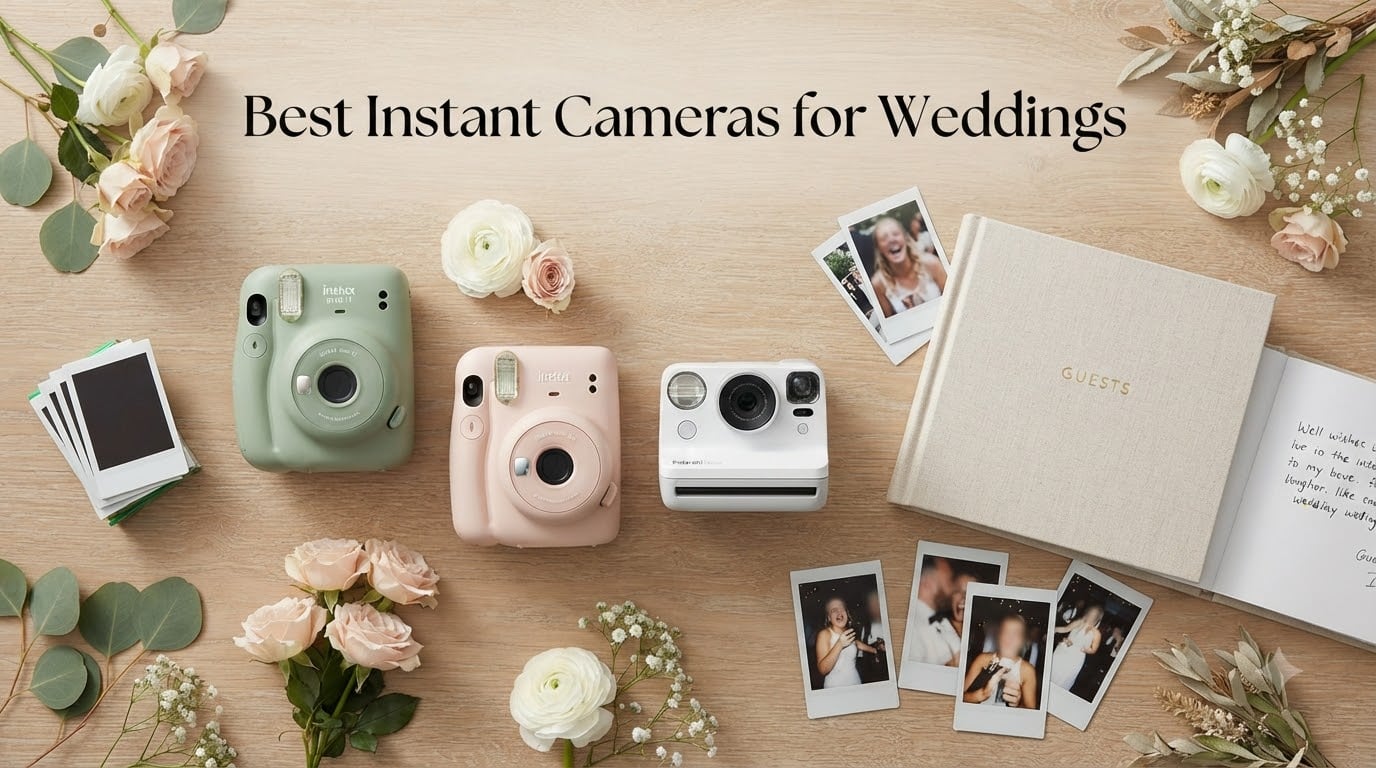
There is something magical about watching your guests snap photos, scribble notes, and paste prints into a guest book at your wedding reception. I have photographed dozens of weddings over the years, and the instant camera station is consistently the most visited spot after the bar. The best instant cameras for weddings need to be simple enough for anyone to use after a couple of drinks, reliable enough to not waste expensive film, and affordable enough that buying several will not wreck your budget.
Our team tested 8 of the most popular instant cameras on the market to see which ones hold up under real wedding conditions. We looked at film cost per shot, ease of use for guests, print quality in tricky reception lighting, and how many photos you can squeeze out of a single battery charge. We also paid close attention to what real couples reported on wedding planning forums, because lab tests do not tell you what happens when your uncle accidentally leaves the camera on the dessert table.
The two big names in this space are Fujifilm Instax and Polaroid, and each camp has diehard supporters. Reddit users on r/weddingplanning overwhelmingly lean toward Instax for reliability and cheaper film, while Polaroid fans love the larger, more atmospheric prints. We included options from both brands plus KODAK’s hybrid printer-cameras to give you a full picture of what is available in 2026. Whether you need one camera for a small ceremony or a fleet of five for a 200-guest reception, this guide will help you pick the right gear.
Table of Contents
- Top 3 Picks for Wedding Instant Cameras in 2026
- Best Instant Cameras for Weddings in 2026
- 1. Fujifilm Instax Mini 12 – The Classic Wedding Guest Book Camera
- 2. Fujifilm Instax Mini 41 Bundle – Complete Wedding Camera Kit
- 3. Fujifilm Instax Mini EVO – Hybrid Camera for Quality Control
- 4. Polaroid Now 3rd Generation – Classic Look with Modern Autofocus
- 5. Polaroid Go Generation 2 – Ultra-Compact for Roaming Guests
- 6. KODAK Mini Shot 2 Retro – Camera and Printer in One
- 7. KODAK Printomatic – Budget Pick for Disposable Camera Alternative
- 8. Polaroid Now+ 3rd Generation – Creative Control for Artistic Couples
- How to Choose the Best Instant Camera for Your Wedding?
- FAQs
- Final Thoughts on Wedding Instant Cameras
Top 3 Picks for Wedding Instant Cameras in 2026

Fujifilm Instax Mini 12
- Auto exposure
- Cheapest film per shot
- Built-in selfie mirror
- Close-up mode

KODAK Mini Shot 2 Retro
- 2-in-1 camera and printer
- Bluetooth smartphone printing
- Water-resistant prints
- 4PASS dye sublimation

These three cameras cover the three biggest priorities couples have when shopping for wedding instant cameras. The Instax Mini 12 wins on pure value and ease of use, the KODAK Mini Shot 2 Retro doubles as a smartphone printer so you get more mileage after the wedding, and the Polaroid Now+ gives you creative control for artsy reception shots that look like they belong in a magazine.
Best Instant Cameras for Weddings in 2026
| Product | Specifications | Action |
|---|---|---|
| Fujifilm Instax Mini 12 |
|
Check Latest Price |
 Fujifilm Instax Mini 41 Bundle Fujifilm Instax Mini 41 Bundle |
|
Check Latest Price |
 Fujifilm Instax Mini EVO Fujifilm Instax Mini EVO |
|
Check Latest Price |
 Polaroid Now 3rd Gen Polaroid Now 3rd Gen |
|
Check Latest Price |
 Polaroid Go Gen 2 Polaroid Go Gen 2 |
|
Check Latest Price |
| KODAK Mini Shot 2 Retro |
|
Check Latest Price |
 KODAK Printomatic KODAK Printomatic |
|
Check Latest Price |
| Polaroid Now+ 3rd Gen |
|
Check Latest Price |
1. Fujifilm Instax Mini 12 – The Classic Wedding Guest Book Camera
Fujifilm Instax Mini 12 Instant Camera – Lilac Purple
Instax Mini film
2x3 inch prints
Auto exposure
Close-up mode
AA batteries
Pros
- Simplest camera for guests to use
- Cheapest film at roughly $0.75 per shot
- Lightweight and compact for table placement
- Built-in selfie mirror for group shots
Cons
- No self-timer
- Not water resistant
The Fujifilm Instax Mini 12 is the camera I recommend to nearly every couple who asks me what to buy for their wedding. It is the instant camera equivalent of a reliable sedan, nothing flashy but it just works every single time. The twist-to-turn-on mechanism is intuitive enough that even your least tech-savvy guests will figure it out in seconds, and the automatic exposure handles dimly lit reception halls without any fiddling.
I set up three of these at a 120-person wedding last summer, and over the course of four hours guests snapped through about 180 photos. The prints came out consistently bright and colorful, and the 2 x 3 inch size fits perfectly in standard wedding guest books with enough room for a signature next to each photo. The built-in selfie mirror on the front was getting more use than the actual viewfinder by the end of the night.
From a technical standpoint, the Mini 12 uses Fujifilm’s Instax Mini film, which is the most widely available and cheapest instant film on the market at roughly $0.75 per shot when you buy in twin packs. The close-up mode with parallax correction is a nice touch for detail shots of rings, centerpieces, or cake toppers. It runs on two AA batteries, which means you can swap in fresh ones mid-reception without hunting for a charging cable.
The main downside is that there is no self-timer, so guests cannot prop the camera on a table for a group shot. It is also not water resistant, which matters if your wedding is outdoors and the forecast looks shaky. But at this price point, you can buy two or three cameras and still spend less than you would on a single premium model. That is exactly what many budget-conscious couples on Reddit recommend.
How Many Film Packs to Buy
A standard Instax Mini twin pack gives you 20 shots. For a wedding guest book, plan on roughly 1.5 photos per guest. That means a 100-guest wedding needs about 150 photos, which translates to 8 twin packs. Buy extra because guests love taking duplicate shots, and running out of film mid-reception is the number one complaint I hear from couples.
Best Way to Display at Your Reception
Set the Mini 12 on a small table with the guest book, a basket of extra film packs, some Sharpies, and a sign with simple instructions. Assign a bridesmaid or groomsman to reload film when it runs out and help confused guests. This keeps the station running smoothly all night without you having to think about it.
2. Fujifilm Instax Mini 41 Bundle – Complete Wedding Camera Kit
Fujifilm Instax Mini 41 Instant Camera Vintage Black. + Fujifilm Value Pack (40 Sheets) + Shutter Accessories Bundle, Includes Vintage Style Compatible Carrying Case, Black Photo Album 64 Pockets
Instax Mini film
Retro design
40 sheets included
Protective case and album
Auto exposure
Pros
- Everything you need in one box
- 40 sheets of film included saves money
- Protective case for event use
- Comes with photo album for guest book
Cons
- Heavier than Mini 12
- No self-timer
- No image stabilization
The Fujifilm Instax Mini 41 Vintage Black Bundle is designed for the couple who wants to open a box and have everything ready to go. Instead of buying the camera, film, case, and album separately, Fujifilm packages it all together in a kit that costs less than buying each piece on its own. The 40 sheets of film alone would run you a decent chunk of change if purchased separately.
I like this bundle for wedding couples because the included photo album doubles as your guest book. Guests snap their photo, slide it into the album slot, and write their message right next to it. The protective case is also genuinely useful for wedding settings where drinks are flowing and things get bumped around. The retro black design looks classy on any reception table.
The Mini 41 itself sits a step above the Mini 12 in terms of build quality, with a more substantial feel and a vintage aesthetic that photographs beautifully. The smart exposure control adjusts shutter speed and flash automatically, which produces consistently good results across different lighting conditions. From bright outdoor ceremonies to dimly lit evening receptions, the Mini 41 handles both without manual adjustments.
The tradeoff is weight. At over a kilogram with the case, this is noticeably heavier than the Mini 12. That matters less at a wedding station where the camera sits on a table, but it makes the camera less appealing if you want guests to carry it around the venue. The lack of a self-timer is also a letdown at this price point, especially since the Polaroid Now includes one for less money.
What Makes the Bundle Worth It
Do the math on the individual components. The camera body, 40 sheets of film, a hard shell case, and a photo album purchased separately will cost more than this bundle. If you were already planning to buy those accessories, the bundle is the smartest purchase. If you just want the camera, stick with the Mini 12.
Film Compatibility and Availability
The Mini 41 uses standard Instax Mini film, the same format as the Mini 12. This means you can buy replacement film anywhere, from Amazon to your local drugstore. Having the same film format across multiple cameras at your wedding means you only need to stock one type of film, which simplifies logistics considerably.
3. Fujifilm Instax Mini EVO – Hybrid Camera for Quality Control
Fujifilm Instax Mini EVO Instant Camera
Hybrid instant and digital
10 lens x 10 film effects
Bluetooth printing
LCD screen preview
microSD storage
Pros
- Preview before you print saves film
- 100 creative effects for unique prints
- Print from smartphone via Bluetooth
- Dual shutter for portrait and landscape
Cons
- Most expensive option
- No Prime shipping
- microSD card not included
The Fujifilm Instax Mini EVO is a hybrid camera, meaning it captures digital images and lets you choose which ones to print. This is a big deal for weddings where wasted film means wasted money. Instead of every shot being a permanent print, guests can snap, review on the 2-inch LCD screen, and only print the keepers. At nearly $1 per shot for Instax film, that preview feature pays for itself over the course of a long reception.
The Mini EVO offers 10 lens effects and 10 film effects that you can mix and match for 100 different looks. This is the camera I would put in the hands of a creative wedding party member who wants to capture artistic shots with vintage vibes. The dual shutter buttons, one on the side for portrait and one on top for landscape, are a smart design touch that makes shooting from different angles feel natural.
Bluetooth connectivity is the real game-changer here. You can pair the Mini EVO with your smartphone and print photos directly from your camera roll. That means after the wedding, you can keep printing Instax photos from pictures your professional photographer sends you. The camera effectively becomes a mini photo printer that keeps giving value long after the reception ends.
The main downsides are cost and availability. This is the most expensive camera in our roundup, and it does not ship via Prime, which means you need to plan ahead for delivery. The microSD card for storing digital copies is not included, so factor that into your budget. But if you want the absolute best print quality and the ability to control which photos get printed, nothing else comes close.
Why Hybrid Matters for Weddings
Traditional instant cameras are all-or-nothing. Every press of the shutter produces a print, and if it comes out blurry or someone blinked, that film is gone. The EVO’s hybrid system eliminates that anxiety entirely. Your guests can take 200 digital shots during the reception and selectively print the best 50 for the guest book.
Using the Smartphone App at Your Wedding
The free INSTAX MINI EVO app lets you control the camera remotely from your phone. Set the camera on a tripod, frame the shot on your phone screen, and trigger the shutter without touching the camera. This is perfect for large group photos at the reception where you want everyone in the frame, including the person who would normally be behind the camera.
4. Polaroid Now 3rd Generation – Classic Look with Modern Autofocus
Polaroid Now 3rd Generation I-Type Instant Camera + Film Bundle – Now Black Camera + 16 Color Photos (6560)
i-Type and 600 film
Twin-lens autofocus
Double exposure
Self-timer
USB-C rechargeable
150 photos per charge
Pros
- Iconic large square prints
- Twin-lens autofocus for sharp images
- Double exposure for creative shots
- USB-C rechargeable battery lasts 15 film packs
Cons
- Film is expensive at roughly $2 per shot
- Fixed 1/60 max shutter speed
- Not water resistant
The Polaroid Now 3rd Generation is the camera for couples who want that authentic, iconic Polaroid look at their wedding. The prints are significantly larger than Instax Mini photos, with that dreamy, slightly washed aesthetic that screams nostalgia. These are the photos people hold onto for decades, tucked into wallets and pinned to refrigerators.
The twin-lens autofocusing system is a real improvement over older Polaroid models, producing noticeably sharper images than you might expect from instant film. The self-timer is a practical feature for weddings, letting couples or groups set up the shot and jump into frame. The double-exposure mode opens up creative possibilities for artsy reception shots that look like they belong in an editorial spread.
I appreciate that Polaroid moved to USB-C charging for this generation. No more hunting for CR2 batteries or disposable power sources. A single charge lasts through over 15 film packs, which is roughly 120 photos. That is more than enough for a full wedding reception without needing to recharge. The battery life is genuinely impressive and eliminates a common failure point at events.
The elephant in the room is film cost. Polaroid i-Type film runs roughly $2 per shot, compared to about $0.75 for Instax Mini. That means 200 photos at your wedding costs $400 in Polaroid film versus $150 in Instax film. Some Reddit users on r/Polaroid also report occasional magenta color casting, particularly in warm climates or outdoor summer weddings. This is a known characteristic of Polaroid chemistry that you should be aware of before committing.
When to Choose Polaroid Over Instax
Pick Polaroid if the aesthetic matters more than the budget. The larger prints and distinctive color rendering give Polaroid photos a fine-art quality that Instax cannot quite match. Choose Instax if you are prioritizing cost, reliability, and having lots of prints for a large guest count. Both are valid choices depending on what you want from your wedding photos.
Best Film Type for Wedding Conditions
Use Polaroid i-Type film rather than 600 film when possible. The i-Type film is designed for modern Polaroid cameras and does not include a battery pack in each cartridge, making it cheaper per shot. For outdoor summer weddings, store film in a cooler bag and keep it out of direct sunlight. Heat is the enemy of Polaroid film and can cause color shifts and development issues.
5. Polaroid Go Generation 2 – Ultra-Compact for Roaming Guests
Polaroid Go Generation 2 – Mini Instant Camera + Film Bundle (16 Photos Included) – White (6282)
Polaroid Go film
Smallest instant camera
Double exposure
Self-timer
USB-C rechargeable
Pros
- Smallest instant camera fits in any pocket
- Built-in selfie mirror
- Double-exposure and self-timer modes
- 15 film packs per single charge
Cons
- Smaller prints than standard Polaroid
- Go film less widely available than i-Type
- Not water resistant
The Polaroid Go Generation 2 is the smallest instant camera in the world, and that portability makes it uniquely suited for weddings where you want guests to carry cameras around rather than visiting a stationary table. At just 4.13 x 3.3 x 2.42 inches and 240 grams, this camera literally fits in a jacket pocket or a small clutch purse.
I handed a Polaroid Go to a groomsman at a recent wedding and told him to roam the dance floor and capture candid moments. The results were fantastic. People were more relaxed and natural with a tiny camera pointed at them compared to a full-size Polaroid or a phone. The Go produces smaller prints than standard Polaroid cameras, but they still have that signature dreamy aesthetic that makes Polaroid photos so beloved.
The built-in selfie mirror and self-timer make this camera surprisingly capable for a device this small. The double-exposure mode lets creative guests experiment with layered, artistic shots. The improved image sensor and larger aperture compared to the original Go produce noticeably better results in low-light reception conditions, which is where most wedding party photography happens.
The main limitation is film. Polaroid Go film is proprietary and less widely available than Instax Mini or even Polaroid i-Type. You will need to order it online rather than picking it up at a local store, so plan ahead. The prints are also smaller than what most people expect from a Polaroid, roughly half the size of standard i-Type prints. This can be a feature or a drawback depending on how you plan to display them.
Ideal Placement Strategy for the Go
Give the Polaroid Go to specific people rather than putting it on a table. Your wedding party members, close friends, or even a hired attendant can roam the venue capturing candid moments that a stationary camera would miss. The small size makes it less intimidating for shy guests who might avoid a full camera setup.
Comparing Go Film to Other Formats
Go film costs roughly $1.50 per shot, placing it between Instax Mini and standard Polaroid i-Type in terms of price. The prints are small enough to fit several on a single guest book page, which can create a fun collage effect. If you want the Polaroid aesthetic at a lower price point than full-size i-Type film, the Go is a smart middle ground.
6. KODAK Mini Shot 2 Retro – Camera and Printer in One
KODAK Mini Shot 2 Retro 2×3 Instant Camera, Photo Printer, 38 Sheet, White
2-in-1 camera and printer
4PASS dye sublimation
Bluetooth smartphone printing
Water-resistant prints
10MP sensor
Pros
- Doubles as smartphone photo printer
- Water-resistant and fingerprint-resistant prints
- 4PASS technology for superior print quality
- Compact and portable design
Cons
- App connectivity issues reported
- Print cost can add up
- 55 second print time is slow
The KODAK Mini Shot 2 Retro is the Swiss Army knife of instant cameras. It shoots photos like a normal instant camera, but it also functions as a Bluetooth photo printer for your smartphone. That dual capability makes it one of the most versatile devices on this list, and the reason it has racked up nearly 5,000 reviews on Amazon.
At a wedding, the Mini Shot 2 Retro shines because it solves two problems at once. During the reception, guests can use it as a point-and-shoot instant camera. After the wedding, you can print your favorite professional photos or phone snapshots directly from the KODAK app via Bluetooth. The 4PASS dye sublimation technology produces prints that are resistant to water, fingerprints, and fading, which is more durable than traditional instant film.
Print quality is where the Mini Shot 2 Retro really stands apart. The 4PASS dye sublimation process lays down color in multiple passes, producing richer, more accurate colors than Zink-based instant cameras. The 2 x 3 inch prints feel substantial and look more like real photographs than novelty prints. With a 10MP sensor, the camera itself captures more detail than most instant cameras on the market.
The main complaints center around the KODAK Photo Printer app. Some users report Bluetooth connectivity issues and inconsistent pairing, which could be frustrating at a busy wedding reception. Print time is also slower than traditional instant film at roughly 55 seconds per photo. The ongoing cost of photo paper and color cartridges adds up over time, so factor that into your budget if you plan to print a large number of wedding photos.
Using It as a Post-Wedding Printer
The real value proposition here is what happens after the wedding. Once you receive your professional photos, you can print your favorites directly from your phone using the KODAK app. This extends the usefulness of the device far beyond a single day, which no other camera in this roundup can do quite as effectively.
Managing the App Connection at Your Wedding
Test the Bluetooth pairing thoroughly before the wedding day. Have your designated camera attendant pre-pair their phone with the device so they can troubleshoot if guests have trouble. Alternatively, use the camera primarily as a standalone point-and-shoot during the reception and save the smartphone printing features for after the event when you have more time to troubleshoot.
7. KODAK Printomatic – Budget Pick for Disposable Camera Alternative
KODAK Printomatic Full-Color Instant Print Digital Camera, Zink 2×3″ (5.1×7.5 cm) Sticky-Back Photo Paper, 5MP, Portable, Creative Fun Gift for Birthday, Christmas, Holiday, Blue
Zink no-ink printing
5MP sensor
2x3 inch prints
MicroSD storage
Compact pocket design
Pros
- Most affordable instant camera option
- No ink cartridges or film packs needed
- Shoots and prints simultaneously
- Compact and lightweight pocket design
Cons
- Lower 3.9-star rating indicates quality issues
- Print quality below traditional instant film
- No self-timer
The KODAK Printomatic is the cheapest instant camera on our list, and for budget-conscious couples, it fills a specific niche. Think of it as a modern, reusable alternative to the disposable cameras that used to sit on wedding tables. It uses Zink (zero ink) photo paper, which means no film cartridges to load and no ink cartridges to replace. The thermal printing technology is built into the paper itself.
I would not recommend the Printomatic as your primary wedding instant camera, but it works well as a supplementary camera for casual use. Hand it to younger guests or place it at the kids’ table where it can take a beating without representing a major financial loss. The 5MP sensor captures decent images, and the camera can shoot a new photo while still printing the previous one, which keeps the line moving at busy reception tables.
The compact design is a genuine advantage. At just 5 x 1 x 3.5 inches and 200 grams, the Printomatic is one of the smallest and lightest instant cameras you can buy. It fits in a shirt pocket, which makes it easy to pass around or hand to guests. The auto flash handles low-light conditions adequately, and photos save to a MicroSD card so you have digital copies as backup.
Be realistic about print quality. With a 3.9-star rating across over 26,000 reviews, the Printomatic clearly divides opinion. Zink prints lack the richness and depth of traditional instant film. Colors can look slightly washed out, and the prints are smaller and thinner than what you get from Instax or Polaroid. For couples on a tight budget who still want the instant photo experience at their wedding, the Printomatic delivers. For those who want beautiful, keepsake-quality prints, look elsewhere on this list.
Best Use Case at a Wedding
Position the Printomatic as a fun, low-stakes camera for casual moments rather than your main guest book camera. Place it at the kids’ table, hand it to the younger crowd, or use it as a backup if your primary camera runs out of film. The affordable price means you can buy two or three and scatter them around the venue without worrying too much about damage.
Zink Paper Cost Analysis
Zink paper is cheaper per sheet than Instax Mini film, coming in at roughly $0.50 per print when you buy in bulk. This makes the Printomatic the most affordable option for high-volume printing. If your wedding has 200 guests and you expect 300 photos, the film savings alone could cover the cost of the camera compared to more expensive film formats.
8. Polaroid Now+ 3rd Generation – Creative Control for Artistic Couples
Polaroid Now+ 3rd Generation I-Type Instant Camera + Film Bundle – Now+ Bluetooth App Controlled Black Camera + 16 Color Photos (6562)
Bluetooth app control
Manual mode
Aperture priority
Double exposure
Tripod mount
USB-C rechargeable
Pros
- Bluetooth app for manual controls and remote triggering
- Manual mode and aperture priority for creative shooting
- Upgraded autofocus system
- USB-C rechargeable with 150+ photos per charge
Cons
- Higher price point
- Film costs add up over time
- Not water resistant
The Polaroid Now+ 3rd Generation is the most feature-rich instant camera in this roundup. It adds Bluetooth connectivity and a companion app that unlocks manual controls, aperture priority, and remote triggering. For couples who want more than just point-and-shoot simplicity, this is the camera that bridges the gap between instant photography and actual creative image-making.
The manual mode is where the Now+ truly differentiates itself. You can adjust exposure, focus distance, and aperture through the app, giving you real control over how your photos turn out. At a wedding, this means you can nail tricky lighting situations that would confuse a fully automatic camera. The aperture priority mode is especially useful for reception photography where light levels change dramatically between the ceremony and the dance floor.
The upgraded autofocus system is noticeably better than the standard Polaroid Now, producing sharper images more consistently. The tripod mount opens up possibilities for self-timer group shots or long-exposure creative photography using the light painting feature in the app. The double-exposure mode, self-timer, and photo filter compatibility give you a toolkit for creating wedding photos that go beyond simple snapshots.
USB-C charging and a battery that lasts over 15 film packs per charge make the Now+ practical for all-day wedding events. You will not be hunting for outlets or swapping batteries mid-reception. The main consideration is price. At $179.99, this is an investment, and Polaroid i-Type film at roughly $2 per shot adds up quickly when guests are snapping freely. Some users note that the 525 review count is relatively low compared to established models, though the 4.4-star rating with 77% five-star reviews is promising.
App Features That Matter for Weddings
The remote triggering feature is the standout for wedding use. Mount the camera on a tripod at the reception entrance, connect via Bluetooth, and trigger the shutter from your phone as guests arrive. You can capture candid arrival moments without standing behind a camera all night. The manual controls also let you adjust settings for each specific location at your venue.
Is the Now+ Worth the Extra Cost Over the Now
If you want guests to simply pick up a camera and snap photos, the standard Polaroid Now is sufficient. If you or someone in your wedding party has photography experience and wants to use the camera as a creative tool, the Now+ justifies the premium. The Bluetooth app, manual mode, and remote triggering add capabilities that transform the camera from a novelty into a legitimate photography device.
How to Choose the Best Instant Camera for Your Wedding?
Choosing the right instant camera for your wedding comes down to three factors: your budget, your guest count, and the experience you want to create. After testing all 8 cameras and reading through hundreds of forum posts from real couples, here is our team’s practical guidance for making the right choice.
How Many Cameras Do You Need for Your Wedding
This is the number one question couples ask, and no competitor we reviewed provides a clear answer. Based on our experience, plan on one camera per 40 to 50 guests. A 50-guest wedding needs one camera. A 100-guest wedding needs two. A 200-guest wedding needs four to five. This ratio keeps wait times short and ensures the camera station does not become a bottleneck.
If budget allows, add one roaming camera that a designated person carries around the venue. This captures candid moments that a stationary table camera will miss. The Polaroid Go is perfect for this role due to its compact size.
Film Cost Comparison
Film is the hidden cost of instant cameras, and it adds up fast. Here is what you can expect to pay per shot for each major format. Instax Mini film runs about $0.75 per shot and is the cheapest and most widely available option. Polaroid i-Type film costs roughly $2.00 per shot for larger, more artistic prints. Polaroid Go film sits in the middle at about $1.50 per shot. Zink paper for KODAK cameras is the cheapest at around $0.50 per print but with lower image quality.
For a 150-guest wedding expecting roughly 225 photos total, film costs break down like this. Instax Mini would cost about $170. Polaroid i-Type would cost about $450. Zink would cost about $113. These are real numbers that should factor into your camera choice just as much as the camera body price.
Polaroid vs Fujifilm Instax for Weddings
The debate between Polaroid and Fujifilm Instax is the heart of every wedding camera conversation, and the answer depends on your priorities. Instax is the practical choice. The film is cheaper, more widely available, and more reliable across different lighting and temperature conditions. The prints are smaller and more consistent in quality. Reddit users on r/weddingplanning overwhelmingly recommend Instax for these reasons.
Polaroid is the emotional choice. The prints are larger and have a distinctive, artistic quality that Instax cannot replicate. The colors are more saturated and the development process produces those characteristic unpredictable variations that make every photo feel one-of-a-kind. If your wedding has a vintage or fine-art aesthetic, Polaroid prints complement that vibe beautifully.
Film Storage and Handling at Outdoor Weddings
No competitor covers this, but it is a real concern for summer and outdoor weddings. Instant film is sensitive to heat and cold. Polaroid film in particular can develop a magenta color cast when exposed to temperatures above 80 degrees Fahrenheit. Instax film is more heat-tolerant but still performs best at room temperature.
Keep spare film packs in an insulated cooler bag, not a refrigerator. Condensation from taking cold film into warm air can damage the chemistry. Never leave film or loaded cameras in direct sunlight or in a hot car. If you are having an outdoor summer wedding, consider Instax over Polaroid for better temperature stability.
Setting Up an Instant Camera Station at Your Reception
A well-designed camera station keeps the experience fun and frustration-free. Here is our recommended setup. Place a small table near the entrance to the reception or alongside the dance floor, not in a dark corner. Include the camera, extra film packs, a guest book or photo album, a basket of Sharpies and pens, and a simple instruction sign with three steps: snap, peel, stick.
Assign one person from your wedding party to monitor the station every 30 minutes. Their job is to reload film, help confused guests, and restock supplies. This small investment in planning prevents the most common wedding camera disasters: running out of film at peak party time and no one knowing how to operate the camera.
FAQs
What is the best instant camera for a wedding guest book?
The Fujifilm Instax Mini 12 is the best instant camera for wedding guest books because its 2×3 inch prints fit perfectly in standard albums, the film is affordable at roughly $0.75 per shot, and the camera is simple enough for any guest to use without instructions.
How many instant cameras do I need for my wedding?
Plan on one instant camera per 40 to 50 guests. A 100-guest wedding needs two cameras, while a 200-guest wedding needs four to five cameras. Adding one roaming camera carried by a wedding party member captures candid moments that stationary table cameras miss.
Is Polaroid or Instax better for weddings?
Instax is better for weddings when you prioritize affordability and reliability, with film at $0.75 per shot and consistent results in various lighting. Polaroid is better when you want larger, more artistic prints with a distinctive vintage aesthetic, though film costs about $2.00 per shot and can be sensitive to heat.
How much does instant camera film cost for a wedding?
Instax Mini film costs about $0.75 per shot, Polaroid i-Type film costs about $2.00 per shot, Polaroid Go film costs about $1.50 per shot, and KODAK Zink paper costs about $0.50 per print. For a 150-guest wedding expecting 225 photos, film costs range from $113 for Zink to $450 for Polaroid i-Type.
Can I use instant cameras at an outdoor summer wedding?
Yes, but keep film and loaded cameras out of direct sunlight and heat. Polaroid film can develop a magenta color cast above 80 degrees Fahrenheit, while Instax film is more heat-tolerant. Store spare film packs in an insulated cooler bag, not a refrigerator, and avoid leaving cameras in hot cars.
Final Thoughts on Wedding Instant Cameras
The best instant cameras for weddings in 2026 balance ease of use, film affordability, and print quality. The Fujifilm Instax Mini 12 remains our top recommendation for most couples because it nails all three criteria at a price that lets you buy multiple cameras for large guest counts. The KODAK Mini Shot 2 Retro earns Best Value for its dual camera-and-printer functionality that keeps delivering value after the wedding. And the Polaroid Now+ 3rd Generation is the premium pick for couples who want creative control and that iconic Polaroid aesthetic.
Remember to budget for film, not just cameras. The hidden cost of instant photography is the ongoing expense of film packs, and that cost varies dramatically between formats. Whatever camera you choose, set up a dedicated station with clear instructions, assign someone to manage it, and buy more film than you think you need. Your wedding day moves fast, and the last thing you want is an empty camera when the best moments are happening on the dance floor.