
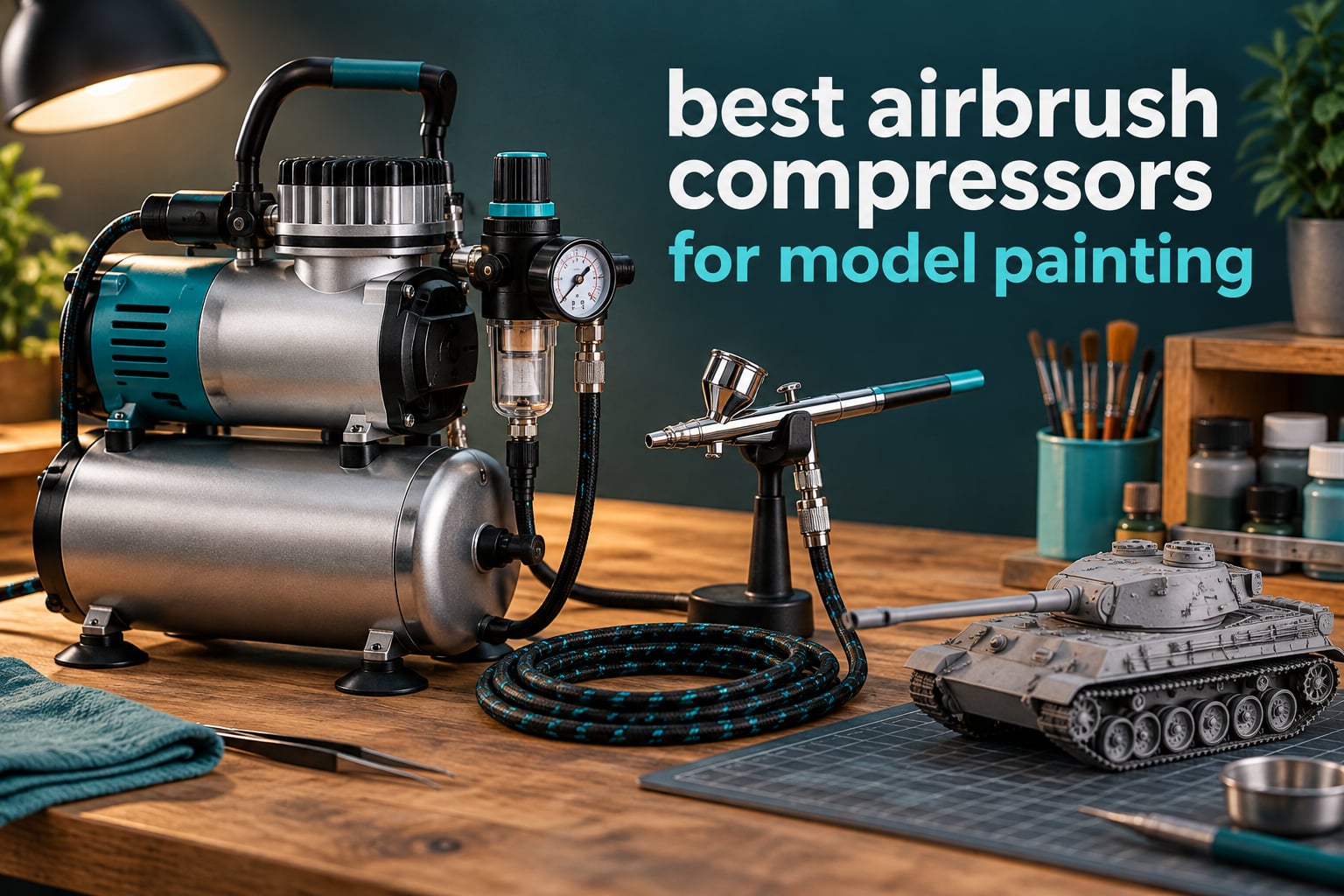
A speckled base coat is almost never a paint problem. It is nearly always a pressure problem, and the pump sitting on the floor beneath your bench is the reason. We spent weeks working through the specs, owner reviews and real-world noise figures on every airbrush compressor worth owning for scale models, wargaming miniatures and 3D printed parts, and this is the list we would hand to a friend who wanted one machine to do priming, base coats and detail work.
The honest truth about the best airbrush compressors for model painting is that the tank and the regulator matter more than the badge on the front. An oil-less pump, a real pressure gauge, a moisture trap and enough receiver volume to stop the air pulsing are the four things that decide whether your spray comes out smooth. Everything else is preference. That is why the picks below include plain no-name tanked units alongside units from Iwata and Paasche, and why a generic-branded tanked unit takes one of our top slots.
Everything below was picked against the same checklist: rated and reviewed output, a stated noise figure, tank or regulator data, and an honest weakness that a buyer should know about before checkout. We also weighed footprint heavily, because the most common regret we found in painting forums is a unit that is simply too big for the space it has to live in. If you also need air for tools around the house, our guide to the best air compressors for home garages covers a different class of machine entirely.
Last reviewed and updated in 2026.
Table of Contents
- Top 3 Picks for Model Painting in 2026
- What PSI Do You Need for Model Painting?
- All 10 Compressors at a Glance
- How We Chose These Compressors
- 1. Master Airbrush Cool Runner II Kit – Best All-Rounder
- 2. TIMBERTECH Airbrush Kit with Compressor – Best Value Set
- 3. Master Airbrush Multi-Purpose Kit with Mini Compressor – Best Budget Starter
- 4. Timbertech ABPST08 3L Tank Compressor – Best for Fine Detail
- 5. PointZero 1/5 HP Tanked Compressor – Best Regulated Airflow
- 6. Gaahleri Turbox Mini Kit – Best for Tiny Benches
- 7. Cool Tooty 3L Metal Tank Compressor – Best Under-Desk Fit
- 8. MEEDEN 7002 Quiet Compressor – Best for Shared Spaces
- 9. Iwata Ninja Jet – Best Warranty Cover
- 10. Paasche D3000R – Best for Paasche and 1/4 Inch Airbrushes
- Buying Guide: Choosing an Airbrush Compressor for Models
- Frequently Asked Questions
- Final Verdict for Model Painters
Top 3 Picks for Model Painting in 2026

Master Airbrush Cool Runner II Kit
- 1/5 HP single-piston compressor with dual fans
- Three airbrushes plus paint set
- Built-in holder for two brushes
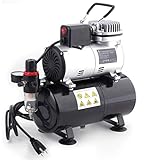
Timbertech ABPST08 3L Tank
- 3 litre tank for pulse-free output
- Regulator with gauge and water trap
- Runs at roughly 47-50 dB
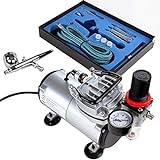
TIMBERTECH Kit with Compressor
- Oil-free piston with manometer and filter
- Three nozzle sizes included
- Quiet 50 dB operation
If you only read one section, read that. The Cool Runner II is the safest single purchase because it arrives complete and has the largest review base of anything in this group. The Timbertech ABPST08 is the better machine if you already own good airbrushes and want tank stability. The TIMBERTECH kit is the most direct route to a working setup that a beginner can grow out of.
What PSI Do You Need for Model Painting?
For scale models, treat 15 to 18 PSI as the bare minimum, 22 PSI for thin airbrush-only paints, and 30 PSI as a sensible working target. Most painters settle on 20 to 25 PSI for base coats and drop toward 15 to 20 PSI for freehand detail lines. Anything above 35 PSI is aimed at heavy airbrush paints and tends to push fine miniatures off the model as overspray.
One number matters as much as the setting itself: pressure under the trigger, not pressure on the gauge. Air is being consumed faster than the pump can replace it, so the delivered figure always sits below the set figure, and the gap widens on tankless units. That is why a steadier machine lets you paint thinner and in fewer passes instead of fighting speckle with more light coats.
All 10 Compressors at a Glance
| Product | Specifications | Action |
|---|---|---|
| Master Airbrush Cool Runner II Kit |
|
Check Latest Price |
| TIMBERTECH Kit with Compressor |
|
Check Latest Price |
 Master Airbrush Multi-Purpose Kit Master Airbrush Multi-Purpose Kit |
|
Check Latest Price |
| Timbertech ABPST08 3L Tank |
|
Check Latest Price |
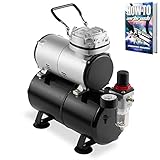 PointZero 1/5 HP Tanked Compressor PointZero 1/5 HP Tanked Compressor |
|
Check Latest Price |
 Gaahleri Turbox Mini Kit Gaahleri Turbox Mini Kit |
|
Check Latest Price |
 Cool Tooty 3L Metal Tank Cool Tooty 3L Metal Tank |
|
Check Latest Price |
 MEEDEN 7002 Quiet Compressor MEEDEN 7002 Quiet Compressor |
|
Check Latest Price |
 Iwata Ninja Jet Iwata Ninja Jet |
|
Check Latest Price |
 Paasche D3000R Paasche D3000R |
|
Check Latest Price |
How We Chose These Compressors
Every unit here was checked against the same five questions. Does it hold pressure without pulsing? Can you read the pressure or regulate it accurately? Is the pump oil-less, so no lubricant reaches your paint or your model? Is there a moisture trap between tank and airbrush? And is the stated noise figure low enough for the room you paint in?
We weighted review volume heavily, because a compressor is a simple machine and its weaknesses show up clearly once a few hundred people have used it. We also read every one-star review we could find for each product. A machine with an impressive spec sheet and a pile of identical complaints about the same part is not a pick, however good the numbers look.
1. Master Airbrush Cool Runner II Kit – Best All-Rounder
Master Airbrush Cool Runner II Air Brush Kit with Air Compressor Dual Fan
0.8 CFM airflow, 0.2 HP single piston, 9 pounds, 6 ft hose, three airbrushes included
Pros
- Largest volume of owner reviews in this group
- Arrives complete with three airbrushes and a paint set
- Dual cooling fans run cooler through long sessions
- Built-in holder keeps two brushes within reach
Cons
- A heavy 9 pound package for a portable setup
- Included brushes are entry-level gravity and siphon feed
This is the kit we keep reaching for when someone asks where to start. You get a 1/5 HP single-piston compressor, two dual-action gravity-feed brushes with 0.3mm and 0.2mm tips, a single-action siphon-feed gun with 2-3/4 oz bottles, a 6-color acrylic paint set and a holder for two airbrushes. Nothing needs to be bought separately on day one.
The dual cooling fans are the part that earns the top spot for long sessions. Owners consistently report it running through an evening of base coating without the heat build-up that stops smaller pumps in their tracks, and the spray pattern stays even at working pressure. At 0.8 CFM it is not going to drive a spray gun, and it does not need to for model work.
The honest limitation is weight. At 9 pounds this is a substantial package to lift, and carrying it between rooms or to a hobby night is a chore rather than a non-event. If your bench is a fixed desk and the machine lives there permanently, that does not matter at all.
The second limitation is the brushes themselves. The G22 and G25 are perfectly capable dual-action gravity guns, and the E91 siphon gun is useful for larger volumes, but none of them match a dedicated premium airbrush in control. Treat them as learning tools you may replace later while keeping the compressor.
Who this compressor suits
A first-time airbrusher who wants one box to open and start work. It also suits anyone who already hand-paints and wants to add zenithal priming and base coats without researching compatible parts.
If you paint a lot of metallics or large dioramas, the 0.3mm and 0.2mm tips cover it, though you will thin aggressively to get flow at low pressure.
Who should skip this kit
Anyone working in a small apartment at night who needs the quietest possible option, and anyone who already owns a good airbrush and only needs regulated air.
Forum painters who upgraded from budget gear often keep this compressor for years and upgrade only the gun, which tells you the machine itself is not the weak link.
2. TIMBERTECH Airbrush Kit with Compressor – Best Value Set
TIMBERTECH Airbrush Kit with Compressor, Multi-purpose Airbrush Compressor Set, Dual Action Gravity Feed Airbrush with Air Hose for Hobby, Body Tattoo, Model Painting, Automotive Graphic, Make-up
23 L/min airflow, 2.5 bar max, 50 dB, auto start 3 bar and stop 4 bar, three nozzle sizes
Pros
- Complete compressor and dual-action airbrush in one box
- Three nozzle sizes cover detail and coverage
- Quiet enough for evening work
- Easy to clean after sessions
Cons
- Rubber feet slip on a smooth bench
- A few early valve failures reported
- No receiver tank
- so pressure can pulse
This kit pairs an oil-free reciprocating piston compressor with a manometer, regulator, air filter and a dual-action gravity-feed airbrush. You get a 0.3mm nozzle mounted plus spares at 0.2mm, 0.3mm and 0.5mm, a 7 ml metal cup and an approximately 6 ft hose.
With auto start at 3 bar and auto stop at 4 bar, the machine cycles inside a narrow band that is well matched to airbrushable model paints. Owners report successful scale model work and praise the quiet operation for evening sessions. The 23 L/min airflow sits comfortably above what a single dual-action gun consumes.
There is no receiver tank, and you can feel it. Fine line work is where the absence shows, because pressure can dip mid-stroke and the spray sputters. Work at the lower end of the regulator range and it is a non-issue for base coats and shading.
The other recurring complaint is stability. The rubber feet do not grip a smooth bench surface, so the unit can creep or hop while you are working, and a very small number of buyers reported valve failure early on. Check the drain valve before the first session so you know it seals.
Who this kit suits
Beginners on a budget who want a regulated, filtered setup with three nozzle options and no extra purchases. The 0.5mm nozzle is genuinely useful for scenery and larger surfaces.
It also suits anyone who already owns a decent airbrush and just needs a cheap clean-air source for practice and touch-ups.
Who should skip this kit
Anyone chasing razor-thin freehand lines or ultra-smooth base coats on a show piece. A tank solves the pulsing problem in a way this kit cannot.
If your bench surface is smooth glass or laminated board, put a rubber mat down before you start.
3. Master Airbrush Multi-Purpose Kit with Mini Compressor – Best Budget Starter
Master Airbrush Multi-Purpose Air Brush Kit with Mini Air Compressor
2.8 pounds, 10.5 L/min, 25 psi max, 65 dB, 6 ft braided hose, 0.4 cubic feet
Pros
- Light and compact at 2.8 pounds
- Dual-action G22 with widely available parts
- Stops the moment the trigger is released
- Braided hose connects without extra tape
Cons
- Tankless
- so airflow pulses at higher pressure
- No pressure gauge and no water trap
- Inner nozzle is fragile during cleaning
This is one of the lightest complete setups in the group at 2.8 pounds, and it comes with a dual-action gravity-feed G22 airbrush, a C16-B mini compressor, a 6 ft braided hose with 1/8 inch fittings and a beginner guide. At 0.25 HP it delivers 10.5 L/min up to 25 psi.
Its saving grace is the auto shutoff behaviour. The compressor stops as soon as you release the trigger, so it is not running constantly in the background of a long painting evening. For learning thinning ratios, cleaning routines and basic pre-shading, that is enough machine to grow into.
At 65 dB it is the loudest machine in this list, which matters a great deal in a flat or a shared wall. There is also no gauge and no water trap, so you are judging pressure by feel and your airbrush can spit water and paint onto a finished surface.
The G22 parts are a double-edged sword. They are widely available and interchangeable with higher-end Master brushes, but the inner nozzle and tip bend easily during disassembly and the internal cup surfaces are rough and hard to clean thoroughly. Handle the tip with tweezers and a mat, not force.
Who this kit suits
Students, younger modellers and anyone with a very small workspace who needs a portable setup. It handles priming and base coating models cleanly at lower pressures.
It is also a good first kit for a child learning airbrush technique, since the low weight and simple controls reduce the risk of damage.
Who should skip this kit
Anyone in an apartment with thin walls, and anyone whose models are expensive or finished at a high standard. The missing water trap alone is a reason to add a filter before first use.
4. Timbertech ABPST08 3L Tank Compressor – Best for Fine Detail
Timbertech Upgraded Airbrush Single-Piston Oil-free Mini Compressor ABPST08 with Cooling Fan, 3L Tank, Regulator, Moisture trap for Hobby, Body Tattoo, Model Painting, Automotive Graphic, Make-up
3 litre receiver tank, 4 bar max, roughly 47-50 dB, 23 L/min, 12.6 by 5.5 by 12.2 inches
Pros
- Tank delivers genuinely pulse-free air at low pressure
- Quiet enough to hold a conversation beside it
- Cooling fan extends continuous run time
- Water trap and filter keep the line dry
Cons
- Gauge is small with a 0-100 psi range
- No airbrush holder on the base unit
- Some buyers needed a quick-disconnect adapter
This is the machine we recommend to painters who already own a good airbrush and want the air to match it. A 3 litre receiver tank at 0.17 HP feeds 20 to 23 L/min, and because the tank buffers the pump cycle the delivered pressure under the trigger stays close to the set pressure.
Long-term owners report years of leak-free and rust-free service, and describe the tank as the decisive upgrade over tankless units for detail work. The industrial regulator with gauge, water trap, air filter, relief valve and overheat protector is a proper airbrush-grade control set rather than a toy dial.
The gauge is the weak point. It is small and marked across a 0 to 100 PSI range, which makes the 15 to 25 PSI band you actually paint at hard to read precisely. Several owners have replaced it with a 0-60 PSI dial, which is a sensible ten-minute fix.
Two smaller things: there is no airbrush holder on the base, and a few machines needed a quick-disconnect adapter to match their airbrush hose fittings. It is also sold airbrush-only, so do not expect it to drive a spray gun or air tools.
Who this compressor suits
Anyone painting at 15 to 22 PSI with thin airbrushable paints, where pulse-free air is the whole game. It runs happily with mid-tier and premium brushes from Iwata, Badger and Harder and Steenbeck.
Owners who use premium airbrushes often report that this unit outlasts several brushes over its service life.
Who should skip this compressor
Anyone who needs absolute silence in a shared room at odd hours, and anyone who wants a unit that also feeds a spray gun. For a compact footprint, compare the dimensions against your bench before buying.
5. PointZero 1/5 HP Tanked Compressor – Best Regulated Airflow
PointZero 1/5 HP Airbrush Compressor with Air Tank, Regulator, Gauge and Water Trap – Quiet Portable Pump Silver
1.0 CFM airflow, 3 litre tank, 60 psi max, 55 dB, 12 by 12 by 13 inches, 11.7 pounds
Pros
- Large tank plus water trap gives effectively zero pulsation
- Quiet enough for late sessions
- Integrated regulator and gauge
- On-demand cycling reduces motor wear
Cons
- Heavy 11.7 pound build for a portable unit
- Airbrush
- hose and holder sold separately
- Only a 90 day limited warranty
The PointZero is a compressor and nothing else, which is exactly why it works. A precision-forged oil-less piston pushes about 1.0 CFM into a 3 litre tank, and the on-demand cycle runs up to roughly 58 PSI and restarts at 40 PSI rather than idling.
Owners describe the combination of tank and water trap as producing smooth, pulsing-free air for food decorating, body art and hobby airbrushing. The integrated regulator and gauge make pressure easy to set and monitor, and 55 dB is acceptable for indoor work.
At 11.7 pounds this is a heavy unit despite the portable label, so plan where it will live before you commit. It is also sold bare, which means an airbrush, hose and holder all come from your budget separately.
The 90 day limited manufacturer warranty is short compared with the multi-year cover on the branded units here. If you keep equipment for a decade, factor that into the decision.
Who this compressor suits
Painters who already own their airbrush and hose, and want a dependable regulated source of dry air with a large tank behind it. It suits people who spray often and care more about consistency than portability.
It is also a reasonable pairing with a separate spray booth, provided you stay within the airbrush duty rating.
Who should skip this compressor
Anyone with limited bench space or a need to carry the unit between rooms. Anyone shopping for a first all-in-one setup should look at a kit instead.
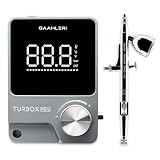
6. Gaahleri Turbox Mini Kit – Best for Tiny Benches
Gaahleri Airbrush Kit, Turbox mini Kit with GHAD-39 0.35mm, Dual-Action Airbrush & Air Compressor with 18 Gear Air Control, Ultra-Quiet, Multi-Scenario, for Painting, Modeling, Cake Decor
8-30 PSI adjustable, digital pressure readout, under 48 dB at 1 m, 1.32 lb, 5.5 by 3.9 by 2.3 inches
Pros
- Digital readout removes pressure guesswork
- 18-gear dial with preset steps
- Under 48 dB measured at 1 m
- Very small and light
- Overheat protection built in
Cons
- Lowest average owner rating in this group
- Tankless
- so displayed pressure is not working pressure
- Single 0.35mm nozzle caliber only
The Gaahleri is the most compact complete kit here by measurement, at 5.5 by 3.9 by 2.3 inches and 1.32 pounds, and it is the only one of our picks with a digital display showing real-time output pressure switchable between PSI and bar. An 18-gear dial with Low, Medium and High presets gives unusually fine steps for a compact unit.
Buyers like the footprint and the repeatability the display provides, which helps beginners get repeatable results instead of guessing. Measured noise under 48 dB at 1 m and a reinforced multi-layer casing keep it discreet on a crowded desk.
Be clear about what that display shows. The design is tankless, so pressure drops while the trigger is pressed and the number on screen is not the pressure reaching your paint. It is a useful reference point, not a guarantee.
The single 0.35mm nozzle caliber with no spare tips limits you to fine work, and the 4.1 average rating with an 11% one-star share points to inconsistent quality control from batch to batch. Treat it as a compact secondary machine rather than the compressor you build a whole workflow around.
Who this kit suits
Painters with a genuinely tiny work area, and anyone who wants to see a number instead of feeling for pressure. Detail work on small miniatures suits the 0.35mm tip well.
It is a good travel and hobby-night companion at just over a pound.
Who should skip this kit
Anyone doing long base-coating sessions, since the small tankless reservoir struggles to keep up at higher pressures. Anyone working on valuable models who cannot risk inconsistent quality from one machine to the next.
Buyers wanting broader spray patterns will want a second nozzle, which is not included.
7. Cool Tooty 3L Metal Tank Compressor – Best Under-Desk Fit
Cool Tooty Airbrush Compressor with 3L Metal Tank, 1/6 HP 110V Motor, Dual Cooling Fans, 47dB, 20–23 L/Min Airflow, Auto Start/Stop, Moisture Filter, and 1/8″ to 1/4″ Adapter
3 litre metal tank, 1/6 HP oil-free motor, 20-23 L/min, under 50 dB, 13.5 by 5.5 by 14 inches
Pros
- Tanked design gives a steady
- sputter-free pattern
- Dual fans keep it cool through long sessions
- Metal tank is easy to drain
- Suction-cup feet keep it planted
- Quiet enough to forget
Cons
- Instructions are thin for the build quality
- Regulator knob is finicky to set
- Sold under a generic label
- A few machines failed to restart
Forum painters who regretted a compact unit and moved to a 3 litre tank singled out this size class out for fitting under a table while staying very quiet. That is exactly what this compressor delivers: a 3 litre metal tank, a 1/6 HP oil-free 110V motor, 20 to 23 L/min and a stated figure under 50 dB.
The dual cooling fans sit in the motor housing and on the piston radiator, so it stays cool through a full session. Owners describe a genuinely steadier spray pattern than small tankless units, a well-made tank that drains easily, and a responsive pressure valve.
Two things to prepare for. The regulator knob is finicky, so set pressure by turning fully down and then backing up slowly. The instruction manual is thin relative to the build quality, so allow yourself ten minutes to work out the layout.
It also carries a generic label rather than a model brand, and a small number of machines failed to restart or arrived with factory leaks. Test it under load as soon as it arrives.
Who this compressor suits
Anyone who has already been disappointed by a tankless unit and wants steady air without a large footprint. The included 1/8 inch to 1/4 inch adapter means it will take most airbrushes directly.
Suction-cup feet keep it stable on a shared bench, which is useful in a hobby room where vibration matters.
Who should skip this compressor
Anyone who wants a legible pressure gauge, since the control is a small knob rather than a dial you can read at a glance. Buyers who need a long-term warranty should note the generic branding.
8. MEEDEN 7002 Quiet Compressor – Best for Shared Spaces
MEEDEN Airbrush Compressor Kit: 1/5 HP Quiet Compressor with 6 ft Hose
47 dB, 23 L/min, 4 bar max, 6 ft hose with moisture filter, two mounted airbrush holders
Pros
- Very quiet and small enough for an apartment desk
- Two permanently mounted airbrush holders
- Electronic self-stop cuts noise between passes
- Manufacturer replaced a failed unit
Cons
- Small tankless reservoir cycles on frequently
- Sliding plastic handle has play
- Compressor-only version has no airbrush included
Buyers compare this unit favorably on noise against the more expensive Master Airbrush kits, and at a stated 47 dB it sits at the quiet end of the machines in the group. The 150W oil-free piston is cooled by an internal fan and pushes 23 L/min up to 4 bar, enough for 0.2 to 1 mm tips.
Two permanently mounted airbrush holders and an external visual pressure barometer are small touches that matter on a cramped desk, and the electronic self-stop function switches the motor off between spray passes. The 6 ft hose carries an inline moisture filter.
The trade-off is the small tankless reservoir, which cycles on often during a session. That is precisely the arrangement that leaves audible gaps between passes, so it is better suited to detail and touch-up work than to a long base-coating run.
The sliding plastic handle also develops play when extended, and the compressor-only version does not include an airbrush, so budget for one. If you want the bundled set, check the variant carefully before ordering.
Who this compressor suits
Flat dwellers and anyone painting after work when a louder pump would be a problem. The two holders make it efficient when you swap between base and detail brushes.
It is a sensible second machine for a hobby night or a shared studio bench.
Who should skip this compressor
Anyone who wants to lay down long, even base coats and will not tolerate audible cycling. Check the variant listing carefully, because the set and compressor-only versions differ.
9. Iwata Ninja Jet – Best Warranty Cover
Iwata Ninja Jet Airbrush Compressor – 110-120V Quiet Compact Mini Air Compressor with Hose & Adaptors – Maintenance-Free, Adjustable Pressure – For Hobbyists, Artists, Cake & Model Painting
Oil-less zero-maintenance piston, 9 litre tank, 15 psi listed, 62 dB, 8.65 by 6.18 by 2.25 inches, 5 year warranty
Pros
- Recognized brand with a 5 year limited warranty
- Compact and light
- Adapters for Badger
- Aztek and Paasche included
- Holds up for priming and base coating
Cons
- No pressure gauge
- only a plus/minus dial
- No integrated moisture filter
- Airbrush sold separately
The Ninja Jet is the branded option in this list, and the reason to buy it is the 5 year limited warranty on an oil-less, zero-maintenance piston motor. Forum painters regularly note that Iwata compressors are excellent but pricey, and the warranty is the concrete part of that premium you can actually measure.
It is also a flat, shelf-friendly unit at just 2.25 inches tall and 8.65 by 6.18 inches across, so it slides into a drawer rather than needing floor space. Adapters for Badger, Aztek and Paasche airbrushes are included, which removes the most common compatibility complaint on hobby forums.
There is no pressure gauge, only a plus and minus adjustment dial, which adds a learning curve for beginners. There is also no integrated moisture filter, so add an inline filter or you will be adding water to a finished model.
Reviews describe adequate pressure for short bursts of work rather than long sessions, and a few owners report an audible hum that is louder than budget alternatives, with isolated reports of units overheating early in their life.
Who this compressor suits
Painters who want long-term cover on the machine and already own an airbrush. It suits hobbyists who paint occasionally, and the included brand adapters make it the safest choice if you have mixed equipment on the bench.
Who should skip this compressor
Anyone who wants a pressure gauge or a built-in moisture trap, and anyone sensitive to a 62 dB hum in a quiet room. Beginners who want to read and adjust pressure precisely should look elsewhere.
10. Paasche D3000R – Best for Paasche and 1/4 Inch Airbrushes
Paasche D3000R 1/5 HP Compressor with Tank, Regulator and Moisture Trap, Blue & Black
1/5 HP oil-free piston, 3/4 gallon tank, up to 35 psi, 47 dB, 10 by 4 by 8 inches
Pros
- Very quiet at a stated 47 dB
- Tank cuts pulsing for a constant stream
- Moisture trap strips water effectively
- Complete package with regulator and adapter
Cons
- Fittings can leak until properly taped
- Adapter fitting is prone to weeping
- Thick paint on the cooling fins
- 1 year parts and labor warranty
The D3000R is among the quietest tanked compressors in this group at a stated 47 dB, and owners of loud pumps value that heavily. A 3/4 gallon tank, a moisture trap and up to 35 PSI give enough headroom for higher-end airbrushes and enough stored air to hold a smooth stream through detail work.
It comes as a complete package: compressor, regulator, moisture trap and an adapter for competitor hoses. It fits the Paasche 1/4 inch NPT fitting directly and includes a 1/8 inch BSP adapter, which solves the connector mismatch that trips up a lot of mixed-brand setups.
Setup is the dominant complaint. The supplied NPT fittings are frequently out of tolerance and leak until they are properly taped, and the adapter fitting is also prone to weeping. Several owners describe the arrival as a mechanical task rather than a plug-and-play experience, so budget an evening and some thread seal tape.
Two further notes. Thick paint coating over the cooling fins insulates them, so keep overspray off the unit. And a few machines did not hold tank pressure and were returned, which is worth knowing given the shorter one-year parts and labor warranty.
Who this compressor suits
Paasche owners, and anyone whose airbrush uses the wider quarter inch connection. The tank volume and 35 PSI ceiling suit thicker airbrushable paints and slightly larger models.
Owners who upgraded from budget compressors report the jump in quietness and pressure stability justifies the price difference.
Who should skip this compressor
Anyone who wants to open the box and start spraying immediately without any fitting work. Buyers who will not drain the tank regularly should know that a neglected tank corrodes from the inside.
Buying Guide: Choosing an Airbrush Compressor for Models
Tank or no tank
A receiver tank is the single biggest upgrade for finish quality. Without one, the pump cycles while you spray, so delivered pressure falls under the trigger and the spray pulses. With a 3 litre tank you get roughly a minute of steady air before the pump needs to catch up.
Tankless units are fine for practice, for touch-ups and for very fine work at low pressure. They are poor choices for base coating a full model in one session.
Noise, measured against your actual constraint
For a flat or a shared wall, treat the published figure as the deciding number rather than a footnote. Under 48 dB is the quiet zone and suits evening work, 50 to 55 dB is comfortable in a normal hobby room, and above 60 dB is where neighbours start commenting.
Users repeatedly chose units by decibel figure first, and the regret stories on forums are almost always about noise or size rather than air quality. If you paint in a small space, weigh footprint in the same breath as volume.
Pressure control and gauges
A real gauge lets you dial in 18 PSI and return to it next session. A plus and minus dial means you learn pressure by ear, which is slower and less repeatable. A digital display sits between the two: useful, but on a tankless unit it shows a figure that is not what reaches the paint.
Remember that the delivered pressure is always below the set pressure. Set a little higher than your target and let the machine settle.
Oil-less pumps and moisture
Choose an oil-less piston. Lubricated pumps can put oil into the air line, which contaminates paint and settles on finished models. Every unit in this list is oil-free.
A moisture trap is not optional. Forum users who skipped one reported inadvertently soaking a mini, and the reason is simple: compressed air cools as it leaves the tank and water condenses inside the hose. A trap between tank and airbrush costs very little and prevents it.
Fittings and compatibility
Most hobby airbrushes run 1/8 inch, with 1/4 inch as the other common standard. The wide quarter inch fitting used by some brands needs an adapter, and cheap adapters leak. Buy the adapter from the compressor or airbrush maker rather than a generic pack.
If you own mixed equipment, the Iwata Ninja Jet and the Paasche D3000R both ship with brand adapters for the common alternatives, which removes the most common forum complaint on this topic.
Maintenance that prevents rust
Drain the tank after every session. Water remaining inside a steel tank corrodes it from the inside out, and the failure arrives years later as a ruptured seam. Open the drain valve, let the tank empty, then close it.
Also check that a moisture trap bowl drains properly rather than weeping back into the line, and wipe overspray off the cooling fins so the motor keeps shedding heat.
Matching your compressor to your airbrush
A common thread across painting forums is that the compressor is not the place to spend, while the airbrush is. A mid-tier compressor driving a good airbrush will out-perform an expensive compressor driving a cheap bundled brush, and a decent compressor will outlast several brushes over its life.
On value, brand badges and house-brand machines deliver broadly similar air. The differentiators we would pay extra for are tank volume, a legible gauge, a water trap and a cooling arrangement that survives long sessions.
Frequently Asked Questions
Which airbrush compressor is best for models?
The Master Airbrush Cool Runner II kit is the safest all-round choice for scale models because it includes three airbrushes, a paint set and a dual-fan compressor with the largest review base in this group. Painters who already own a good airbrush should pick a tanked unit such as the Timbertech ABPST08 with its 3 litre tank, regulator, gauge and water trap, which delivers pulse-free air at low pressure.
What psi for airbrushing models?
Treat 15 to 18 PSI as the minimum, 22 PSI for thin airbrush-only paints, and 30 PSI as a working target. Most painters use 20 to 25 PSI for base coats and drop to 15 to 20 PSI for freehand detail. Delivered pressure under the trigger sits below the gauge reading, so set slightly higher than your target and let the machine settle.
Which air compressor is the quietest for airbrushing?
Among these picks the Gaahleri Turbox Mini is quietest at under 48 dB measured at 1 m, followed by the MEEDEN 7002 and the Paasche D3000R, both stated at 47 dB, and the Timbertech ABPST08 at roughly 47 to 50 dB. For evening work in a flat or shared space, stay at or below 50 dB and avoid tankless units that cycle on frequently.
Do I need a tanked compressor to airbrush models?
A tank is strongly recommended for anything beyond practice and touch-ups. A 3 litre receiver tank buffers the pump cycle so pressure stays steady while you spray, which removes the speckling that tankless units cause on base coats. Tankless designs are acceptable for detail work at low pressure and for beginners learning thinning and cleaning, but they cycle audibly and the delivered pressure drops under the trigger.
Are all airbrushes compatible with all compressors?
Most hobby airbrushes use 1/8 inch fittings and connect to any regulated compressor, but some brands use the wider 1/4 inch connection and need an adapter. Badger, Aztek and Paasche fittings are the ones that trip people up, and cheap generic adapters are a common leak source. Buy the adapter from the compressor or airbrush maker, and add an inline moisture trap regardless of which unit you choose.
Final Verdict for Model Painters
The Master Airbrush Cool Runner II kit is our pick for the best airbrush compressors for model painting because it removes every decision: brushes, paint, hose and a dual-fan compressor in one box, backed by the largest owner base in this group. If you already paint by hand and want to upgrade, the Timbertech ABPST08 with its 3 litre tank is the better machine, and it will happily drive a mid-tier airbrush for years.
For tight spaces and shared walls, work down the noise list rather than the price list. The Gaahleri Turbox Mini, the MEEDEN 7002 and the Paasche D3000R all sit at or below 48 dB, and the forum consensus is clear that noise and footprint drive regret more than air quality. Whichever you choose, add an inline moisture trap, drain the tank after every session, and spend your real money on the airbrush. Our guide to portable air compressors for nail guns covers a different class again, and the camera picks for model railroad photography will help you record the results once the paint is dry.