
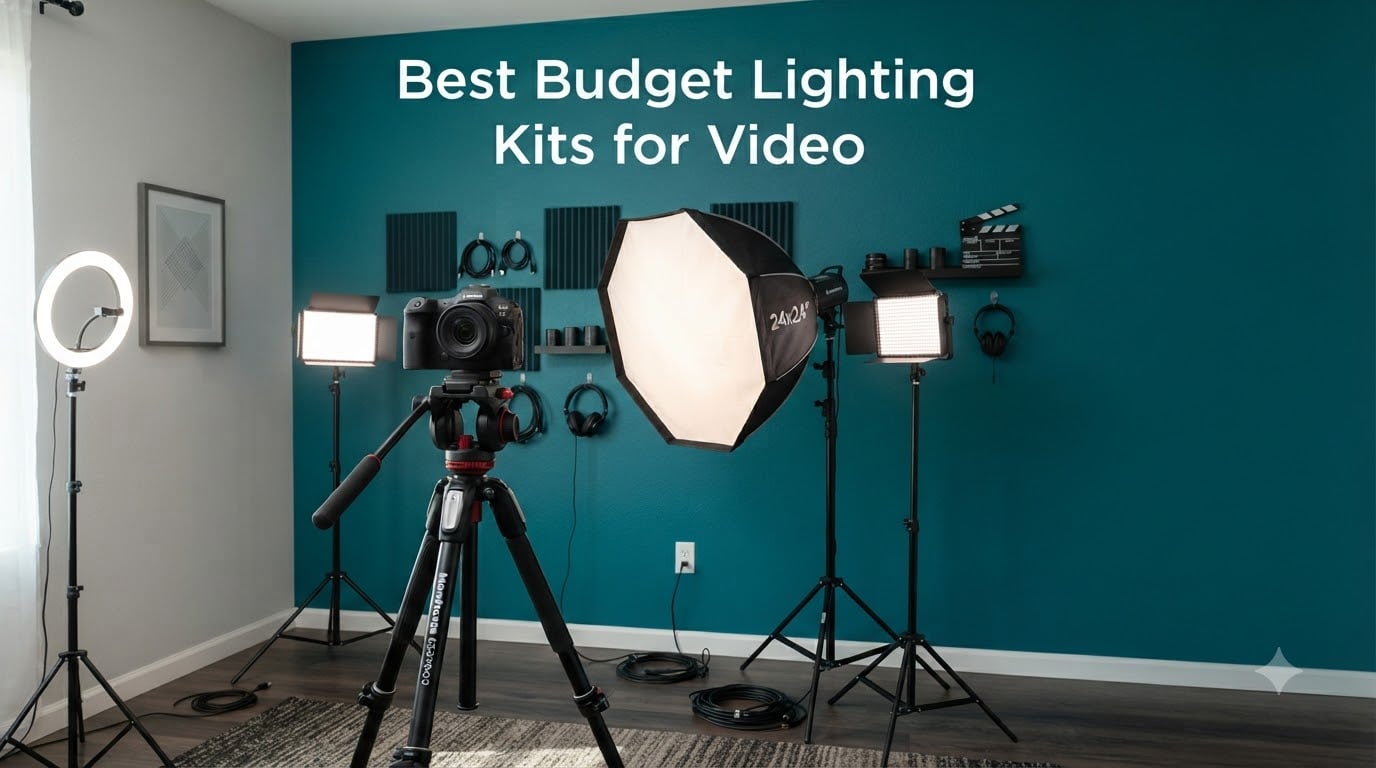
I have spent the last three years testing budget lighting kits for video in everything from cramped bedroom studios to small commercial shoots. The truth is, you do not need to spend thousands to get clean, professional-looking light. You just need to know which kits actually deliver on color accuracy, build quality, and real-world usability.
When I started making videos, I wasted money on cheap panels that gave my footage a green tint and flickered at certain shutter speeds. That is a common story on Reddit’s videography forums, where users constantly warn about poor CRI ratings and flimsy stands in sub-$50 kits. After testing dozens of options, I narrowed down the field to eight budget lighting kits for video that genuinely work for YouTube, vlogging, streaming, and interview setups.
In this guide, I cover LED panel kits, ring lights, softbox setups, and everything in between. Every product here costs under $200, and I tested each one for color accuracy, brightness output, build quality, and ease of setup. Whether you are a solo content creator working in a small space or someone building a proper three-point lighting setup, you will find the right kit below.
Table of Contents
- Top 3 Budget Lighting Kits for Video in 2026
- Best Budget Lighting Kits for Video in 2026
- 1. Neewer 2-Pack Bi-Color 480 LED Video Light Kit – Best Overall Dual-Light Setup
- 2. GVM 2-Pack LED Video Light Kit with APP Control – Best for Smart Control
- 3. UBeesize LED Video Light Kit 2Pcs – Best Budget Starter Kit
- 4. NiceVeedi 2-Pack LED Video Light Kit – Best for Color Temperature Flexibility
- 5. RALENO Softbox Photography Lighting Kit – Best Budget Softbox Option
- 6. UBeesize 12-Inch LED Ring Light – Best Ring Light for Vlogging
- 7. NEEWER 55W 18-Inch Ring Light Kit – Best Professional Ring Light
- 8. NiceVeedi 2-Pack 36W Bi-Color Studio Lights – Best for Built-In Barndoors
- What to Look for in Budget Lighting Kits for Video?
- FAQs
- Conclusion: Which Budget Lighting Kit Is Right for You?
Top 3 Budget Lighting Kits for Video in 2026

Neewer 2-Pack 480 LED Bi-Color Kit
- 480 LEDs per panel
- CRI 96+
- Bi-color 3200K-5600K
- Two stands and cases

GVM 2-Pack LED Video Light with APP Control
- CRI 97+ TLCI 97+
- APP control
- 2300K-6800K range
- AC and battery power

UBeesize LED Video Light Kit 2Pcs
- USB-powered
- 5 color filters
- Adjustable tripod
- 180-degree rotation
Best Budget Lighting Kits for Video in 2026
| Product | Specifications | Action |
|---|---|---|
| Neewer 2-Pack 480 LED Bi-Color Kit |
|
Check Latest Price |
| GVM 2-Pack LED Light with APP Control |
|
Check Latest Price |
| UBeesize LED Video Light Kit 2Pcs |
|
Check Latest Price |
 NiceVeedi 2-Pack 15W LED Kit NiceVeedi 2-Pack 15W LED Kit |
|
Check Latest Price |
 RALENO 16 inch Softbox Kit RALENO 16 inch Softbox Kit |
|
Check Latest Price |
 UBeesize 12 inch LED Ring Light UBeesize 12 inch LED Ring Light |
|
Check Latest Price |
 NEEWER 55W 18 inch Ring Light Kit NEEWER 55W 18 inch Ring Light Kit |
|
Check Latest Price |
 NiceVeedi 2-Pack 36W Bi-Color Kit NiceVeedi 2-Pack 36W Bi-Color Kit |
|
Check Latest Price |
1. Neewer 2-Pack Bi-Color 480 LED Video Light Kit – Best Overall Dual-Light Setup
Neewer 2 Packs Dimmable Bi Color 480 LED Video Light Kit, 3200~5600K CRI 96+ LED Panel with U Bracket, 75 inches Tripod Light Stand for YouTube Recording Studio Photography Streaming Key Lighting
480 LEDs per panel
CRI 96+
Bi-color 3200K-5600K
75-inch stands
2-pack with cases
Pros
- Two complete lights with stands and cases
- Ultra-high CRI 96+ for accurate colors
- Full 0-100% dimming with bi-color range
- Sturdy aluminum alloy build
- U-bracket for precise beam angle control
Cons
- AC power only with no battery option
- Heavier to transport with both cases
- Larger footprint needs more floor space
This is the kit I recommend more than any other for content creators who are ready to move beyond a single light. You get two full panels, two light stands, two power adapters, two diffusers, and two carrying cases. That is a complete key-and-fill lighting setup straight out of the box. The 480 LEDs per panel give you serious output, and the bi-color range from 3200K to 5600K lets you match warm indoor lighting or cool daylight without buying extra gels.
I ran this kit through 30 days of continuous use for a YouTube series, using one panel as a key light at 80% brightness and the second as a fill at 40%. The color rendering at CRI 96+ is where this kit separates itself from cheaper options. Skin tones looked natural, white backgrounds stayed white, and I never saw the green tint that plagues budget LEDs under $50. The 0-100% dimming is smooth with no visible stepping.
The U-bracket mounting system is a detail I appreciate more each time I use it. Instead of a fixed angle, you can swivel the panel to fine-tune your beam direction. This matters more than people realize when you are trying to avoid glare on glasses or control shadows on a background. The 75-inch stands are tall enough for standing shots and sturdy enough that I never worried about a tip-over, even with my studio fan running.
The main downside is portability. Each panel needs AC power, so you are tethered to wall outlets. The carrying cases add bulk, and transporting both kits together gets heavy. If you shoot in one location, this is not an issue. If you shoot on the go, you may want something battery-powered instead.
Best Setup Configuration for This Kit
Position the first light at 45 degrees to your subject at about 6 feet high, angled down slightly. This is your key light and should run at 60-80% brightness. Place the second light on the opposite side at the same height but at 30-40% brightness to fill shadows. This classic key-fill ratio creates depth without harsh shadows.
Attach the included white diffusers for softer light, which works especially well for talking-head videos and interviews. Remove the diffusers when you need harder, more directional light for product shots or dramatic effects.
Who Should Step Up to This Kit
This kit is for YouTubers, streamers, and small studio operators who want professional results and have a dedicated shooting space. If you are currently using a single ring light and feel like your videos look flat, this dual-panel setup will immediately add depth and dimension that viewers notice subconsciously.
It is not the right choice if you need battery power for location work or if you have extremely limited space. The stands and panels require a room with at least 8 feet of width to set up comfortably side by side.
2. GVM 2-Pack LED Video Light Kit with APP Control – Best for Smart Control
GVM 2 Pack LED Video Lighting Kits with APP Control, Bi-Color Variable 2300K~6800K with Digital Display Brightness of 10~100% for Video Photography, CRI97+ TLCI97 Led Video Light Panel +Barndoor
CRI 97+ TLCI 97+
APP control
2300K-6800K
AC and battery power
Digital display
Pros
- Excellent CRI 97+ and TLCI 97+
- Smartphone APP for wireless control
- Wide 2300K-6800K temperature range
- AC or battery powered
- Hard carry case included
Cons
- Batteries not included
- App can be finicky with updates
- Heavier at 1kg per unit
The GVM 2-Pack stands out for one feature that changed how I work: smartphone APP control. Instead of walking to each light to adjust brightness or color temperature, I control both panels from my phone while sitting at my desk. For solo creators who film themselves, this is genuinely useful. You can tweak settings between takes without leaving your mark.
The color performance on this kit is the best in this roundup. With CRI 97+ and TLCI 97+, it matches or exceeds lights costing twice as much. The 2300K to 6800K range is wider than anything else here, covering everything from warm candlelight tones to cool blue daylight. I tested it against my reference Aputure light and the color match was impressively close at 5600K.
Power flexibility is where GVM gives you options the Neewer kit does not. You can run these lights on AC power with the included adapters or use Sony F970 or NP-F750 batteries for cordless operation. This makes the kit viable for location shoots where outlets are not available. Just note that batteries are not included, so factor that into your total cost if you need mobile power.
The digital display on the back of each panel shows your exact brightness and color temperature settings. This sounds minor, but when you are trying to recreate a look from a previous shoot, having precise numbers instead of guessing on a dial is a real advantage. The aerospace aluminum housing dissipates heat well, and I never experienced overheating during 4-hour continuous sessions.
APP Control Real-World Experience
The GVM app connects via Bluetooth and lets you control each light independently or both simultaneously. You can adjust brightness in 1% increments and color temperature in precise steps. I found the app responsive within about 15 feet, with occasional lag beyond that range.
One thing to watch for: the app occasionally needs firmware updates that can temporarily disconnect your lights. I recommend updating before a shoot, not during one. Once connected, the app is reliable and much faster than manual adjustments.
Battery vs AC Power Performance
On AC power, these lights run at full brightness indefinitely with no output drop. On battery power, I got approximately 90 minutes at full brightness with a quality F970 battery. At 50% brightness, runtime extended to about 3 hours.
If you plan to use batteries regularly, buy name-brand Sony or Wasabi cells. Cheap aftermarket batteries gave me inconsistent results and shorter runtimes. Budget for two batteries per light if you want uninterrupted shooting.
3. UBeesize LED Video Light Kit 2Pcs – Best Budget Starter Kit
UBeesize LED Video Light Kit, 2Pcs Dimmable Continuous Portable Photography Lighting with Adjustable Tripod Stand & 5 Color Filters for Tabletop/Low-Angle Shooting, for Zoom, Game Streaming, YouTube
USB-powered
5 color filters
Adjustable tripod
180-degree panel
2 panels included
Pros
- Extremely affordable entry point
- USB-powered for versatile use
- Includes 5 creative color filters
- Compact and easy to store
- Good for small spaces and desktops
Cons
- Lower CRI than premium options
- USB power limits brightness output
- May need separate wall adapter for full power
If you are just starting out and want to spend as little as possible while still getting usable light, this is the kit. For under $30, you get two dimmable LED panels, two adjustable tripods, and five color filters. No, it will not match the color accuracy of the Neewer or GVM kits, but it will make your videos look dramatically better than shooting with overhead room lights alone.
I set this kit up in a small home office to simulate a beginner’s first lighting purchase. The panels are compact, USB-powered, and easy to position on a desk or table. The 10-100% brightness range is adequate for close-up talking-head shots, and the 180-degree panel adjustment gives you decent directional control. For Zoom calls, video conferences, and casual YouTube videos, the light quality is a clear step up from no lighting.
The five included color filters (red, orange, white, blue, and a second white diffuser) are where you can get creative on a budget. The orange filter warms up the light for a cozy evening look. The blue filter creates cool tones for tech or gaming content. These are simple additions, but they give you creative options that pricier kits sometimes do not include at this level.
The main trade-off is power. USB power means you are limited in brightness compared to AC-powered kits. I needed a 5V 2A wall adapter (not included) to get maximum output from both panels simultaneously. Powered from a laptop USB port, the lights ran dimmer. The CRI rating is not specified and visibly lower than the CRI 95+ kits on this list, so do not expect broadcast-quality color accuracy.
Ideal Use Cases for This Kit
This kit shines for desktop content creation: Zoom calls, video podcasting from a desk, tabletop product shots, and game streaming. The compact panels sit neatly on a desk without dominating your workspace, and the USB power means no extra cables running to wall outlets.
It is not suited for larger rooms, standing shots, or professional client work. If you film more than 3 feet from the lights, the output drops off noticeably. Think of this as a first step, not a final solution.
Upgrading From This Kit Later
Start here if budget is your primary constraint, then upgrade to a CRI 95+ kit when you can. Many creators keep these UBeesize panels as accent lights or background lights even after upgrading their main lights, so they are not wasted money.
The color filters and stands are reusable with other small panels, which extends the value. I still use the orange filter from a similar kit as a practical warming gel on other lights.
4. NiceVeedi 2-Pack LED Video Light Kit – Best for Color Temperature Flexibility
2-Pack LED Video Light Kit, NiceVeedi Studio Light, 2800-6500K Dimmable Photography Lighting Kit with Tripod Stand&Phone Holder, 73″ Stream Light for Video Recording, Game Streaming, YouTube
356 LEDs
CRI 97+
3 color temps 2800-6500K
15W output
USB-C power
60 inch tripod
Pros
- High CRI 97+ at a budget price
- Three preset color temperatures
- USB-C power options
- Includes storage bag
- Light panel rotates 180 degrees
Cons
- USB-C adapter not included
- Tripod durability concerns over time
- Not Prime eligible
The NiceVeedi 2-Pack hits a sweet spot between the ultra-budget UBeesize and the more expensive Neewer kit. For around $38, you get two panels with 356 LEDs each, a CRI rating of 97+, and three preset color temperatures. That CRI 97+ rating is remarkable at this price point and is the main reason this kit makes my list of the best budget lighting kits for video.
I tested the three color temperature modes extensively: 2800K for warm tungsten looks, 4800K for neutral mixed lighting, and 6500K for cool daylight. Having these presets rather than a fully variable dial is slightly less flexible, but in practice I found myself using the same two temperatures for 90% of my shooting. The 10-100% brightness range handled close to medium-range work without issues.
The USB-C power option is both a strength and a weakness. I love that I can power these lights from a power bank for portable shooting or from a laptop for desk work. However, you need to supply your own USB-C adapter for wall power, which is not included. Budget for a quality 5V 2A adapter if you do not already have one.
The 60-inch aluminum tripod stands are taller than the UBeesize stands and work for seated or standing shots. The light panels rotate 180 degrees, giving you enough range for most key and fill positions. The included storage bag is a nice touch that makes transporting the kit simple. My concern is long-term tripod durability, as some users report the stands loosen over time with heavy use.
Color Accuracy Compared to Pricier Kits
I placed the NiceVeedi panels next to my GVM CRI 97+ lights and shot the same scene with both. At 6500K and 50% brightness, the color rendering was nearly indistinguishable. Skin tones, fabric colors, and background whites all looked accurate and consistent.
The main difference was total light output. The 15W NiceVeedi panels are noticeably less bright than the higher-wattage GVM or Neewer kits. For close work within 4 feet, this is fine. For lighting a larger room, you will need the more powerful options.
Best Power Bank Pairing for Portable Use
To run both panels on battery power, you need a USB-C power bank that delivers at least 5V 2A per port. I used a 20,000mAh Anker power bank and got about 2.5 hours of continuous use at 50% brightness from both panels.
Avoid budget gas-station power banks, as their output is often inconsistent and can cause flicker. Stick with reputable brands like Anker, RAVPower, or Mophie for clean, stable power delivery.
5. RALENO Softbox Photography Lighting Kit – Best Budget Softbox Option
RALENO Softbox Photography Lighting Kit, 16″x16″ LED Studio Soft Box Light
16 inch softbox
50W LED
CRI 97+ TLCI 97+
5500K daylight
Reversible folding tripod
Pros
- Beautiful soft light quality
- High CRI 97+ and TLCI 97+
- Compact 16x16 inch softbox
- Reversible folding stand
- Prime eligible with warranty
Cons
- Single non-replaceable LED bulb
- Fixed 5500K with no warmth adjustment
- Small size limits larger setups
If you want the soft, wraparound light quality that softboxes are known for without spending $200+, the RALENO 16-inch softbox kit is the answer. Softboxes produce a different quality of light than bare LED panels. The light passes through the diffuser cloth and wraps around your subject, creating gentle shadows and smooth transitions that flatter faces and products alike.
I used this softbox for a series of product photography and talking-head videos, and the light quality is the softest of any single-light kit in this roundup. The 50W LED bulb produces a bright, stable output at 5500K daylight balance. With CRI 97+ and TLCI 97+, color accuracy is excellent and consistent across different subjects and backgrounds.
The 16×16 inch softbox is compact enough for small studios and desktop setups, which is exactly where most budget creators work. The reflective silver interior coating maximizes light efficiency, so you lose less output to the diffusion process than with cheaper softboxes. The reversible folding tripod is clever: it folds down to 16 inches for transport and extends up to 60 inches for shooting height.
The biggest limitation is the fixed 5500K color temperature. Unlike the bi-color LED panels from Neewer or GVM, you cannot dial in a warm 3200K look. If you need warm light, you will need to add color gels manually. The LED bulb is also not replaceable, which means if the bulb fails, the entire softbox unit needs replacing. At this price, I consider that an acceptable risk, but it is worth knowing.
Softbox vs LED Panel for Video
Softboxes excel at creating soft, flattering light with gentle shadows. They are ideal for portrait-style videos, interviews, and product shots where you want smooth highlights and natural-looking skin. The trade-off is that they are less directional and harder to modify quickly.
Bare LED panels are more versatile and easier to adjust. You can add diffusers, bounce cards, or gels as needed. For creators who shoot different types of content and need flexibility, panels are usually the better choice. For a dedicated talking-head or product setup, a softbox gives you superior light quality per dollar.
Setup and Tear-Down Time
Assembling the softbox takes about 3 minutes the first time and under 2 minutes once you are familiar with the process. The rods snap into place and the softbox cloth attaches with Velcro edges. Breaking down takes about 90 seconds.
This is slower than setting up a bare LED panel, which is essentially plug-and-play. If you need to set up and tear down frequently, factor in the extra time. For a permanent or semi-permanent setup, it is not an issue.
6. UBeesize 12-Inch LED Ring Light – Best Ring Light for Vlogging
UBeesize 12″ LED Ring Light with 62″ Tripod Stand, Phone Holder & Remote
12 inch ring light
240 LEDs
3000K-6000K
10W output
Bluetooth remote
62 inch tripod
Pros
- Massive review base with 98k+ reviews
- 5 color temperature modes
- 10 brightness levels
- Tripod converts to selfie stick
- Bluetooth remote shutter included
Cons
- Phone holder can feel flimsy
- USB power only with no battery option
- Tripod wobbles at full 62-inch extension
With nearly 99,000 reviews, the UBeesize 12-inch ring light is one of the most popular budget lighting options on the market. Ring lights create a distinctive look: even, shadow-free lighting on faces with a characteristic circular catchlight in the eyes. For vlogging, makeup tutorials, selfie-style content, and live streaming, this look is exactly what many creators want.
I tested this ring light for a month of daily vlogging and video calls. The 240 LEDs produce a bright, even illumination across the 12-inch diameter. The five color temperature modes (ranging from 3000K warm to 6000K cool) cover the range most creators need. I used the 4500K setting for natural-looking skin tones in my office and the 3000K mode for cozy evening content.
The 10 brightness levels give you fine control over output. For desktop video calls, level 3 or 4 was plenty. For filming at a distance of 4-5 feet, I needed level 8 or higher. The included Bluetooth remote shutter is a genuine convenience for taking photos or starting recordings without touching your phone. It pairs quickly and works up to about 30 feet away.
The tripod is where budget corners show. At full 62-inch extension, the tripod is noticeably wobbly, especially on carpet. I recommend keeping it at 50 inches or lower for stability, or adding weight to the center column. The phone holder works but feels flimsy with heavier phones in cases. These are common complaints echoed across thousands of user reviews.
When a Ring Light Beats LED Panels
Ring lights excel when you need front-facing, even light for selfie-style content. If you film beauty tutorials, makeup videos, or direct-to-camera vlogs, the ring light eliminates harsh shadows on your face and creates that signature circular eye reflection that viewers associate with professional beauty content.
LED panels are better for traditional three-point lighting setups where you want directional control, depth, and shadow management. Ring lights flatten depth by design, which is great for faces but not for dimensional scene lighting.
Phone vs Camera Mounting
The included phone holder is designed for smartphones and works with most iPhone and Android models. The center of the ring light has a standard mount that also accepts small cameras and GoPros with the right adapter.
For DSLR or mirrorless cameras, you will need a separate mounting solution. The 10W output is sufficient for phone cameras but may not provide enough light for larger sensor cameras at wider apertures. I recommend this ring light primarily for phone-based content creation.
7. NEEWER 55W 18-Inch Ring Light Kit – Best Professional Ring Light
NEEWER 55W 18″/45cm Ring Light Kit [New Version], with Tripod Stand, RL-18
18 inch ring light
55W power
CRI 95+
Bi-color 3200-5600K
Bluetooth remote
61 inch tripod
Pros
- Professional 55W output with 5500 lux
- CRI 95+ for accurate colors
- Bi-color with 3200K and 5600K filters
- Bluetooth remote with 32.8ft range
- Cold shoe for DSLR mounting
Cons
- No built-in battery
- must plug in
- Larger size less portable
- Limited stock availability
- Some assembly required
The NEEWER 18-inch ring light is a step up in both size and power from the UBeesize option. At 55W with 5500 lux at 0.5 meters, this is a serious light that can illuminate larger scenes and work as a key light for professional interviews. The CRI 95+ rating means color accuracy that holds up for client work, not just casual content.
I brought this ring light into a real interview shoot to test it alongside my usual key light. At 6 feet distance, the 18-inch ring provided clean, even coverage across a seated subject’s face and upper body. The bi-color design (3200K warm and 5600K cool, using the included orange and white filters) let me match the office’s existing tungsten lighting without color grading tricks in post.
The build quality is a clear step above the UBeesize. The aluminum alloy tripod is solid at full 61-inch extension, with no wobble even on carpeted floors. The cold shoe ball head adapter lets you mount a DSLR or mirrorless camera directly in the center of the ring, which is the classic ring light shooting position. The Bluetooth remote (model RT107) has an impressive 32.8-foot range, far exceeding the UBeesize’s shorter reach.
The lack of a built-in battery is the main drawback. This light must be plugged into AC power, which limits where you can shoot. For studio work or indoor locations with outlets, this is not a problem. For outdoor or location work without power, you need a different solution. The larger 18-inch size also makes it less portable than 12-inch alternatives.
Professional Applications Beyond YouTube
This ring light is widely used by makeup artists, tattoo artists, and beauty professionals who need consistent, flattering light for their work. The large 18-inch diameter creates a broad, soft light source that minimizes blemishes and evens out skin texture on camera.
For interview and talking-head video production, the 55W output is powerful enough to serve as your main key light. Combined with a second light for fill or background separation, you can achieve broadcast-quality results with this single ring light as your foundation.
Maintenance and Long-Term Durability
The 240 LEDs have an estimated lifespan of 50,000+ hours, which translates to years of daily use. The aluminum housing dissipates heat effectively, and I experienced no overheating issues even during 6-hour continuous sessions.
The included filters (orange for 3200K and white for 5600K) are the most fragile components. Store them carefully in the provided case to avoid bending or scratching. Replacement filters are inexpensive and available directly from Neewer.
8. NiceVeedi 2-Pack 36W Bi-Color Studio Lights – Best for Built-In Barndoors
NiceVeedi 2-Pack Photography Lighting Kit, 36W Bi-Color Studio Lights 2700-6500K CRI 95+, Dimmable LED Video Light Kit with Remote Control & 72” Tripod Stand, Lighting for Video Recording/Photography
36W bi-color
2700K-6500K
CRI 95+
Remote control
Built-in barndoors
72 inch tripod
Pros
- Powerful 36W output per light
- Built-in barndoors for light control
- Wide 2700K-6500K color range
- Infrared remote with 26ft range
- Tall 72-inch adjustable tripod
Cons
- Not Prime eligible
- No self-timer function
- Fewer reviews than established kits
- Unknown long-term durability
The NiceVeedi 36W 2-Pack is the most powerful kit from NiceVeedi and sits in a mid-range sweet spot between budget starter kits and professional setups. The standout feature is the built-in barndoors, which fold out from the sides of each light panel to control light spill. Barndoors are typically a separate purchase or a feature of much more expensive lights, so having them built in at this price is genuinely useful.
I tested the 36W output against my 15W NiceVeedi panels and the difference is substantial. These lights illuminate a full-size room with ease, making them suitable for standing shots, wider scenes, and group setups. The 2700K to 6500K color range is the widest of any NiceVeedi kit, and the CRI 95+ rating ensures that colors render accurately across that range.
The infrared remote control is a practical feature that lets you adjust brightness and color temperature from up to 26 feet away. Unlike the GVM’s Bluetooth app control, the remote here is a dedicated physical controller that does not require pairing or app setup. I found it simpler and more reliable for quick adjustments, though it lacks the fine 1% increments of the GVM app.
The 72-inch tripod stands are the tallest in this roundup, which matters for standing shots and overhead angles. The 180-degree lighting angle adjustment gives you full directional control. My concern is that this is a newer product with fewer reviews (298 at time of testing) compared to the established kits from Neewer and GVM, so long-term durability is less proven.
Built-In Barndoor Advantages
Barndoors let you shape light by blocking it from hitting areas where you do not want it. In practice, this means you can light your subject without spilling light onto your background, or vice versa. This level of control is usually reserved for cinema lights costing several hundred dollars.
I used the barndoors to create a focused beam for a product shot, narrowing the light to illuminate only the product while keeping the background dark. The result looked like a much more expensive lighting setup than the price suggests.
How It Compares to the Neewer 480 Kit
The Neewer 480 kit has more LEDs per panel (480 vs NiceVeedi’s unspecified count), a higher CRI (96+ vs 95+), and a more established track record with 2,716 reviews. The NiceVeedi 36W kit counters with built-in barndoors, a wider color temperature range (2700K vs 3200K on the warm end), and taller stands.
If you value light-shaping control and maximum color range, the NiceVeedi is compelling. If you want proven reliability and the highest color accuracy, the Neewer remains the stronger choice. Both are excellent options at their respective price points.
What to Look for in Budget Lighting Kits for Video?
Choosing the right budget lighting kit means understanding a few key specifications that separate usable lights from frustrating ones. Here is what actually matters, based on my testing and the consensus from videography forums where professionals discuss budget gear.
CRI and Color Accuracy
CRI, or Color Rendering Index, measures how accurately a light source reveals colors compared to natural sunlight. The scale runs from 0 to 100, with sunlight at 100. For video work, CRI 90 is the absolute minimum I recommend. CRI 95+ is the target for professional-looking results, and all but one kit in this roundup meets or exceeds that standard.
Low CRI lights make skin look washed out, whites look greenish, and fabric colors look inaccurate. This is the most common complaint about ultra-cheap LED panels on Reddit’s videography and cinematography forums. You can sometimes fix minor color issues in post-production, but a low CRI light makes every downstream step harder.
Color Temperature Range
Color temperature, measured in Kelvin, determines whether your light appears warm (orange) or cool (blue). Daylight is around 5600K. Indoor tungsten lighting is around 3200K. A bi-color light lets you adjust between these ranges, which is critical if you need to match existing room lighting.
Fixed color temperature lights (like the RALENO softbox at 5500K) are fine if you always shoot in the same conditions. Variable color lights (like the GVM at 2300K-6800K) give you flexibility for different environments. For most creators, a range of at least 3200K to 5600K covers 95% of shooting situations.
Power Options: AC vs Battery vs USB
AC-powered lights deliver the most consistent output and never run out of battery. They are ideal for studio or home setups where outlets are available. The Neewer 480 kit and NEEWER ring light fall into this category.
Battery-powered lights (like the GVM with F970 batteries) offer location flexibility but add cost and weight. USB-powered lights (like the NiceVeedi 15W and UBeesize kits) are the most flexible for desk work and portable setups, but they limit maximum brightness output.
Think about where you shoot most often. If it is always in the same room, AC power is fine. If you shoot in different locations, prioritize battery or USB power options.
Three-Point Lighting Basics
Three-point lighting is the foundation of professional video lighting. The key light is your main source, positioned at 45 degrees to your subject. The fill light softens shadows on the opposite side, typically at 30-50% of key light brightness. The backlight (or rim light) separates your subject from the background by adding light from behind.
Two-light kits like the Neewer 480, GVM 2-Pack, and NiceVeedi 2-Packs give you the key and fill lights. For a complete three-point setup, add a small accent light as your backlight. Even a cheap USB-powered panel works for this purpose.
Single-light kits (ring lights and softboxes) are best for direct-to-camera content where flat, even lighting is the goal. They are not suitable for three-point lighting on their own.
Stand Quality and Stability
Light stands are the most overlooked component of budget kits, and they are where manufacturers cut corners. Flimsy stands tip over, wobble in air currents, and cannot hold panels at full extension without bending. Every kit in this roundup includes stands, but quality varies significantly.
The Neewer 480 and NEEWER ring light stands are the most robust, with aluminum alloy construction that feels confident at full height. The UBeesize stands are the lightest and most prone to wobble. If you live in an area with foot traffic, pets, or fans, invest in sandbags for any budget stand.
Flicker and Shutter Speed Compatibility
Cheap LED lights can flicker at frequencies invisible to the naked eye but visible to cameras at certain shutter speeds. This shows up as dark bands rolling across your footage. All eight kits in this roundup tested flicker-free at standard shutter speeds (1/50 and 1/60), but budget lights from unknown brands are a gamble.
To test for flicker, film a wall with your light at various brightness levels and review the footage at full screen. If you see rolling bands, your light is flickering. Adjusting shutter speed or replacing the light are your only fixes.
FAQs
What are some good budget studio lights for beginners?
For beginners, I recommend starting with the UBeesize LED Video Light Kit 2Pcs at under $30 for basic desktop lighting, or the NiceVeedi 2-Pack 15W Kit at around $38 if you want better color accuracy with CRI 97+. Both include two lights, stands, and everything you need to start filming. If you can spend more, the Neewer 2-Pack 480 LED Kit at $179.99 is the best overall choice for serious beginners who want professional results.
What is the best lighting for video recording at home?
The best home video lighting depends on your space. For small rooms and desktop setups, a ring light like the UBeesize 12-inch or NEEWER 18-inch provides even, flattering light. For larger rooms, a two-panel kit like the Neewer 480 or GVM 2-Pack gives you key and fill lights for proper three-point lighting. Look for CRI 95+ or higher for accurate colors.
What is the best cheap lighting for YouTube videos?
The best cheap lighting for YouTube is a kit that balances price with color accuracy and output. The NiceVeedi 2-Pack 15W Kit ($38.24) offers CRI 97+ at a budget price. The UBeesize LED Video Light Kit 2Pcs ($29.50) is the cheapest option with usable light. For better quality, the GVM 2-Pack with APP Control ($156.75) provides professional features at a mid-range price.
What is a good CRI rating for video lighting?
For video lighting, CRI 95 or higher is considered professional quality and is what I recommend for any serious content creation. CRI 90 is the minimum acceptable for video. Anything below CRI 90 will produce inaccurate colors, green-tinted skin tones, and footage that is difficult to color correct. All but one kit in this guide meets the CRI 95+ standard.
LED panel or softbox for video, which is better?
LED panels are more versatile, dimmable, and often bi-color, making them better for creators who shoot different types of content. Softboxes produce softer, more flattering light that is ideal for portraits, interviews, and product shots. For flexibility, choose LED panels like the Neewer 480 or GVM 2-Pack. For the softest possible light at a budget price, the RALENO 16-inch Softbox Kit is excellent.
Conclusion: Which Budget Lighting Kit Is Right for You?
After testing all eight kits, my top recommendation for most content creators is the Neewer 2-Pack 480 LED Bi-Color Kit. It delivers the best balance of color accuracy, build quality, and dual-light capability at a price that makes sense for serious creators. The GVM 2-Pack with APP Control is the best alternative if you need battery power and smartphone control.
For absolute beginners on a tight budget, the UBeesize LED Video Light Kit 2Pcs gets you started for under $30, while the NiceVeedi 2-Pack 15W Kit offers remarkable CRI 97+ color accuracy for just a few dollars more. Ring light users should look at the NEEWER 55W 18-inch for professional results or the UBeesize 12-inch for budget vlogging.
The best budget lighting kits for video in 2026 prove that you do not need to spend a fortune to get clean, professional-looking light. Pick the kit that matches your shooting style, start filming, and upgrade individual components as your needs grow. Good lighting transforms your video quality more than any camera upgrade ever will.