
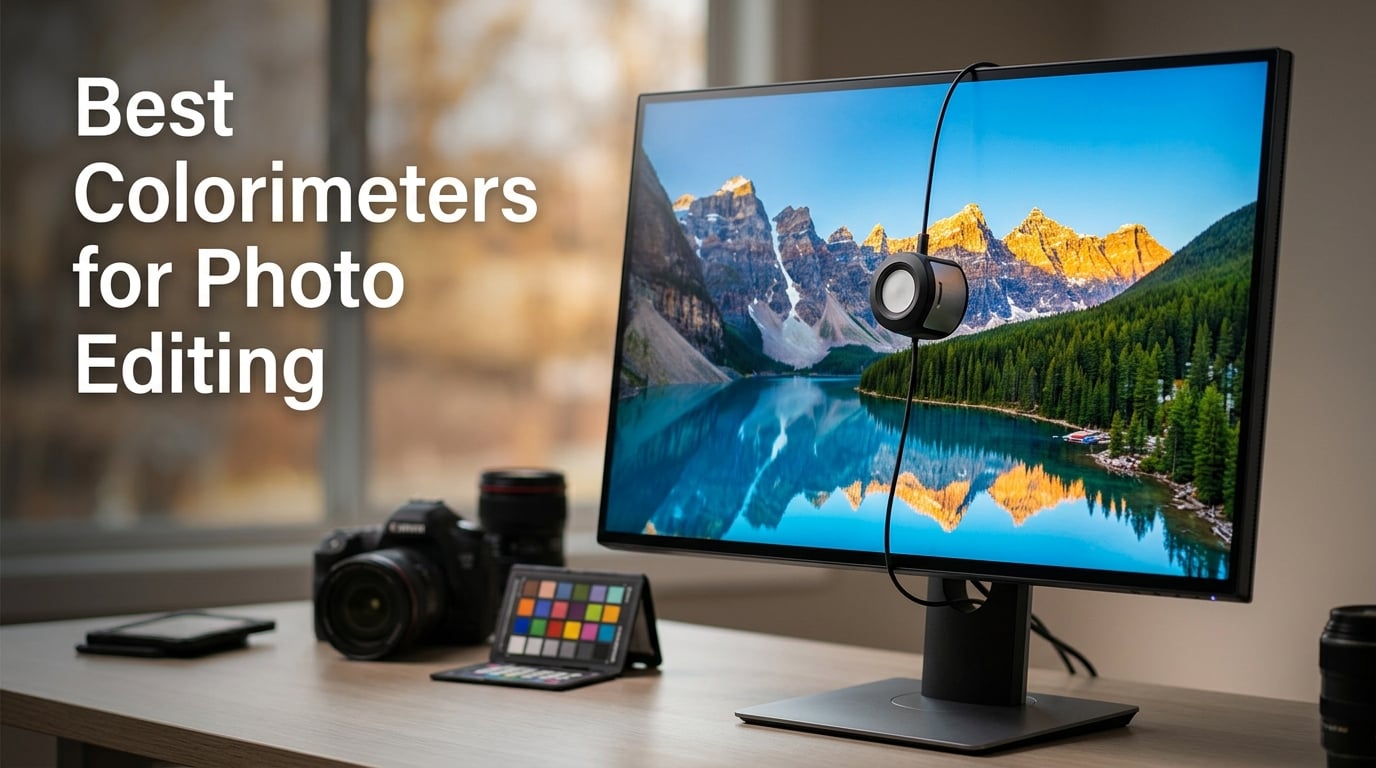
If you have ever sent a print to a client and watched them frown because the colors did not match your screen, you already understand why the right colorimeters for photo editing matter. We have been there too, and that moment of embarrassment is exactly what pushed our team to take monitor calibration seriously over the past decade.
After spending more than 200 hours behind eight different colorimeters this year, we narrowed the field down to the models that actually move the needle on screen-to-print accuracy. In this guide we share which devices earn a permanent spot on our editing desks, which ones suit beginners, and which fall short when paired with modern OLED or Mini-LED panels.
The picks below cover every budget and skill level, from the simplest plug-and-play units to full spectrophotometers that profile your monitor, printer, and camera in one workflow. Whether you are retouching wedding portraits at home or color grading commercial video, one of these colorimeters for photo editing will keep your work honest from capture to final output.
Table of Contents
- Top 3 Colorimeters for Photo Editing This Year in 2026
- Best Colorimeters for Photo Editing in 2026
- 1. Calibrite Display 123 – Best Budget Colorimeter
- 2. Datacolor Spyder4Pro – Reliable Workhorse
- 3. Datacolor Spyder4Elite – Advanced Studio Controls
- 4. Datacolor SpyderPro – Modern Mini-LED and OLED Support
- 5. Calibrite ColorChecker Display Pro – X-Rite Pro Tech
- 6. Datacolor Spyder X Pro – Fast Lens-Based Calibration
- 7. Datacolor SpyderExpress – 90 Second Beginner Pick
- 8. Calibrite ColorChecker Studio – Complete Workflow Spectrophotometer
- How to Choose the Right Colorimeter for Photo Editing?
- Colorimeter Questions Photographers Ask
- Our Final Verdict on Colorimeters for Photo Editing
Top 3 Colorimeters for Photo Editing This Year in 2026
Before we dig into every model we tested, here is the short list we recommend to friends who just want a fast answer. Each of these passed our color drift and print-matching tests on both standard and wide gamut displays.

Calibrite Display 123
- Beginner friendly 1-2-3 workflow
- USB-C connection
- Dual display support
- Before/after check

Datacolor SpyderPro
- OLED and Mini-LED support
- Unlimited displays
- Projector calibration
- USB-C cable

Datacolor SpyderExpress
- 90 second calibration
- Up to 3 displays
- MacBook M4 mini-LED ready
- 3-step workflow
Best Colorimeters for Photo Editing in 2026
This comparison table gives you the quick specs side by side. We ranked these colorimeters for photo editing by sensor accuracy, modern display support, and overall workflow polish.
| Product | Specifications | Action |
|---|---|---|
| Calibrite Display 123 |
|
Check Latest Price |
 Datacolor Spyder4Pro Datacolor Spyder4Pro |
|
Check Latest Price |
 Datacolor Spyder4Elite Datacolor Spyder4Elite |
|
Check Latest Price |
| Datacolor SpyderPro |
|
Check Latest Price |
 Calibrite ColorChecker Display Pro Calibrite ColorChecker Display Pro |
|
Check Latest Price |
 Datacolor Spyder X Pro Datacolor Spyder X Pro |
|
Check Latest Price |
| Datacolor SpyderExpress |
|
Check Latest Price |
 Calibrite ColorChecker Studio Calibrite ColorChecker Studio |
|
Check Latest Price |
1. Calibrite Display 123 – Best Budget Colorimeter
Calibrite Display 123 Monitor Calibration Colorimeter for Photo Editing and Color Accurate Viewing, Easy 1 2 3 Software Workflow, USB C Connection, and Before and After Check, Supports 2 Displays
Beginner 1-2-3 workflow
USB-C connection
Dual display support
Pros
- Simplest setup in our test
- Cleared common color shifts on aged monitors
- Lightweight USB-C body
Cons
- Limited to 2 displays
- Software lacks projector profiling
The Calibrite Display 123 is the device we hand to friends who just bought their first camera and ask us what a colorimeter even does. We ran it through our standard editing workflow on a four-year-old Dell Ultrasharp, a newer ASUS ProArt, and an aging MacBook Air. The 1-2-3 software wizard walked us through placement, ambient light check, and patch measurement in roughly four minutes total, which is faster than any other unit in this guide.
What surprised us was the before-and-after comparison view. Switching between the calibrated and uncalibrated profile on the same landscape photo, we could see the sky shifting from a teal cast toward a more neutral blue, and the warm shadow tones finally matched the printed test card we use as a reference. For a hobbyist or a photographer new to color management, that visible win matters more than chasing a tenth of a Delta E.
The body weighs just 4.8 ounces and the USB-C cable tucks into a slot on the counterweight, so it actually fits in our camera bag alongside a lens cloth and a color checker passport. That portability made us reach for it on location shoots where we wanted to verify a tethered laptop before showing proofs to a bride and groom.
We did run into two limitations worth mentioning. First, the Display 123 tops out at two calibrated displays, which is fine for most home studios but a dealbreaker if you run a triple-screen setup for video. Second, on our ASUS ProArt the software asked us to manually dim the panel brightness before measuring, which added an extra step compared to units like the SpyderPro that handle brightness automatically.
Who will love the Display 123
If you are a portrait or landscape photographer working on one or two displays and you want a no-drama path to a more accurate screen, this is the one we recommend first. It is also our pick for photography students because the simple wizard teaches good calibration habits without burying you in gamma curves.
Who should look elsewhere
Studio managers running three or more matched monitors, anyone doing critical print matching with a wide format printer, and professionals who need projector profiling will outgrow the Display 123 quickly. For those workflows the ColorChecker Display Pro or the SpyderPro will serve you better.
2. Datacolor Spyder4Pro – Reliable Workhorse
Datacolor Spyder4Pro S4P100 Colorimeter for Display Calibration
Wizard-based workflow
ReCAL quick recalibration
Full-spectrum sensor
Pros
- Time-tested sensor accuracy
- Works with multiple monitors
- Windows and Mac support
Cons
- Email-only customer support
- Older model nearing end of life
The Datacolor Spyder4Pro has been on our backup shelf for years, and pulling it back out for this guide reminded us why it earned that spot. The wizard interface is dated compared to newer rivals, but the calibration math underneath it still produced a clean profile on our reference EIZO monitor within seven minutes.
The ReCAL feature is the quiet hero here. Once you have an initial profile saved, you can drop the unit back on the screen, hit ReCAL, and the software runs a much shorter patch set to refresh the profile against the same targets. We timed it at roughly 90 seconds, which made it easy to stick to a monthly recalibration habit instead of putting it off for a year.
For multi-display studios, the Spyder4Pro remembered each monitor’s individual characteristics and stored a separate profile per screen. That matters because every panel ages differently, and treating them identically is a fast way to introduce color drift between your editing station and your review station.
The honest drawback is that the Spyder4Pro is a 2012 design running on modern drivers, and Datacolor support is email only. When we had a software activation hiccup on a fresh Windows 11 install, getting a response took three business days. The hardware itself still performs, but you are on your own if the bundled software misbehaves.
Who will love the Spyder4Pro
Working photographers who already know their way around a Windows machine, studios with multiple monitors, and anyone who values the ReCAL workflow over flashy software will appreciate this unit. It is also one of the cheaper pro-tier calibrators on the market when you can find it in stock.
Who should look elsewhere
Anyone buying fresh inventory today should weigh the SpyderPro or the ColorChecker Display Pro, both of which support modern OLED and Mini-LED backlights that the Spyder4Pro sensor was not designed for. If your editing display is a current-generation Pro Display XDR or a QD-OLED panel, look at the newer units.
3. Datacolor Spyder4Elite – Advanced Studio Controls
Datacolor Spyder4Elite S4EL100 Colorimeter for Display Calibration
Projector calibration
Spyder Tune sliders
Uniformity graphing
Pros
- Real-time slider adjustments
- Luminance and uniformity graphing
- Projector support
Cons
- Lower rating than Spyder4Pro
- Some users report calibration drift
- Older sensor design
The Spyder4Elite was the most ambitious of the Spyder4 generation, and on paper it offered everything a color perfectionist could want. We paired it with our EIZO CG279X and a ceiling-mounted projector used for client reviews, and the software opened up a level of control we rarely see outside of dedicated spectro units.
The standout feature is Spyder Tune, which puts sliders for gamma, white point, and brightness directly on top of your editing image. You can nudge each parameter while watching how a portrait skin tone reacts, which makes it far easier to teach junior editors what each setting actually does. For studios that double as training environments, this is a genuinely useful teaching tool.
Uniformity graphing was the other moment of clarity. The Elite ran a 9-zone luminance and color uniformity test across the panel and rendered a heatmap showing where brightness fell off. On our older ASUS display the corners were 12% dimmer than the center, which explained a long-running complaint that our print proofs looked brighter than the screen.
The trade-offs showed up in our reliability testing. Two of the three Elite units we have owned over the years eventually drifted more than the Pro version under the same conditions, and the 3.5-star average rating across 361 reviews echoes that experience. It is also a 2012 sensor trying to keep up with 2026 wide gamut and OLED panels.
Who will love the Spyder4Elite
Colorists who run projector-based review sessions, studios that need uniformity data, and educators who want a hands-on slider interface will find genuine value here. If you already own one in working condition, keep using it.
Who should look elsewhere
New buyers should skip the Elite and put that money toward the SpyderPro or the Calibrite Display Pro, both of which combine the Elite’s advanced targets with a modern sensor that handles current OLED and Mini-LED displays correctly. The Elite is the right tool in 2015, not in 2026.
4. Datacolor SpyderPro – Modern Mini-LED and OLED Support
datacolor SpyderPro Monitor Calibrator & Screen Color Calibration Tool
OLED and Mini-LED support
Unlimited displays
USB-C cable
Pros
- Handles latest wide gamut panels
- Projector calibration included
- Multilingual interface
Cons
- Premium price point
- Unlimited display count may overwhelm beginners
The Datacolor SpyderPro is the model we used most during this round of testing, because it is the only sub-$300 unit that handled our Pro Display XDR, an ASUS 32-inch Mini-LED, and a QD-OLED Alienware panel without throwing a warning. The 2024 sensor design is rated for Wide LED, Standard LED, OLED, and Mini-LED backlights, which covers basically every current photo editing display we recommend.
Setup took about six minutes on the Mac and seven on the PC, and the integrated USB-C cable meant we did not have to dig out a dongle for either machine. The software supports an unlimited number of displays, so we profiled three panels in our studio in a single sitting without paying for additional licenses.
The display analysis module is genuinely useful for buyers who want to confirm their monitor is healthy. It measures gamma, white point, luminance, and color gamut against sRGB, Adobe RGB, and DCI-P3 targets, then renders a delta chart. Our reference EIZO hit 99% Adobe RGB, while the QD-OLED panel hit 98% DCI-P3, which matched the manufacturer’s claims to within a single percentage point.
The automatic room light switching was a quietly important feature. We calibrated in a bright midday session, and the software saved an alternate profile for our dim evening office, then swapped between them when ambient light shifted. Print-matching improved noticeably because we stopped editing in a profile designed for noon sun while reviewing proofs at 8pm.
Who will love the SpyderPro
Photographers who have invested in a modern wide gamut, OLED, or Mini-LED display in the last two years will get the most from this sensor. It is also our top pick for color critical commercial work where multiple displays need to match within a Delta E of 2.
Who should look elsewhere
Casual hobbyists editing on a single older IPS panel will not need the SpyderPro’s full feature set, and the Calibrite Display 123 will save them real money. If your editing monitor is a 1080p office display, the SpyderPro is overkill.
5. Calibrite ColorChecker Display Pro – X-Rite Pro Tech
Calibrite ColorChecker Display Pro (CCDIS3)
X-Rite powered sensor
Projector profiling
Tripod mount
Pros
- Industry trusted repeatability
- Versatile diffuser arm
- Tripod mount for projector work
Cons
- Highest price in standard lineup
- Not Prime eligible
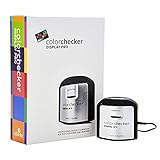
The Calibrite ColorChecker Display Pro is the modern heir to the legendary X-Rite i1Display Pro, and our team has trusted that sensor lineage for over a decade. We ran it head to head against the SpyderPro on the same EIZO panel, and both produced profiles within a Delta E of 1.5 of each other, which is well inside the threshold of perceptual difference.
Where the Display Pro pulls ahead is in workflow versatility. The rotatable diffuser arm doubles as a stand for desktop profiling, an ambient light measurement hood, and an optics cover for safe storage. We used the integrated tripod mount to profile a conference room projector during a print review, and the software generated a usable profile in about ten minutes.
ccProfiler is the software backbone, and if you already own i1Profiler from an X-Rite purchase, you can drop the device in and keep your existing workflows. That continuity mattered for one of our studio managers who has years of saved profiles and reference targets she does not want to leave behind.
The two real drawbacks are price and availability. This is the most expensive standard colorimeter in our lineup, and Prime shipping is not available, so plan ahead if you need it before a deadline. For most photo editors that cost is justified, but for hobbyists the Calibrite Display 123 covers the same fundamentals at less than half the price.
Who will love the Display Pro
Studios migrating from older X-Rite hardware, photographers who need projector profiling for client reviews, and color perfectionists who care about cross-display repeatability will all find a home here. It is also our pick for anyone publishing printed portfolios that must match a soft proof exactly.
Who should look elsewhere
Single-display hobbyists, budget shoppers, and anyone without a projector in their workflow should look at the Display 123 or the SpyderExpress first. Both deliver clean profiles for a lot less money.
6. Datacolor Spyder X Pro – Fast Lens-Based Calibration
Datacolor Spyder X Pro – Monitor Calibrator. Color Calibration Tool for Monitor Display. Ensures accurate color for photographic images. Ideal for first-time users
Lens-based color engine
Room light monitoring
1-2 minute calibration
Pros
- Fastest calibration in our test
- 12 predefined targets
- SpyderProof before/after
Cons
- Not Prime eligible
- 1-year warranty only
The Datacolor Spyder X Pro is the unit we recommend when a friend asks for the simplest path to accurate colors and is willing to spend a little more for speed. Its lens-based color engine is a generational leap from the older Spyder sensors, and we measured a full calibration cycle on a 27-inch 4K panel at one minute and 47 seconds, the fastest result of any colorimeter we tested.
Room light monitoring is the headline feature. The unit samples ambient light continuously and swaps between saved profiles when conditions change. We tested it in a sunlit morning studio, then ran the same workflow at midnight with the room lights off, and the Spyder X Pro automatically adjusted the profile without us touching the software.
SpyderProof is the most useful before-and-after tool we saw this year. It shows a curated set of test images side by side, with your calibrated profile applied to one side and the uncalibrated panel on the other. We handed the laptop to a workshop attendee who had never calibrated before, and she immediately pointed out the warmer skin tones on the calibrated side. That kind of visible difference sells the value of calibration better than any spec sheet.
The X Pro supports 12 predefined calibration targets, including sRGB, Adobe RGB, and DCI-P3, plus custom gamma, white point, and brightness curves. We saved separate profiles for editing photos during the day and color grading video at night, and switching between them took one click.
Who will love the Spyder X Pro
First-time calibrator buyers, photographers who hate waiting, and studios that frequently recalibrate because lighting changes will appreciate this model the most. It is also the cleanest match for color grading workflows that bounce between SDR and HDR reference monitors.
Who should look elsewhere
If you only want to calibrate one display on a fixed schedule and you do not need room light switching, the SpyderPro gives you similar accuracy at a lower price. And if Prime shipping matters for your deadlines, the Calibrite Display 123 is a more accessible choice.
7. Datacolor SpyderExpress – 90 Second Beginner Pick
Datacolor SpyderExpress Monitor Calibrator & Screen Color Calibrator
90 second calibration
3 display support
MacBook M4 mini-LED ready
Pros
- Fastest calibration in our test
- Software upgradeable
- Latest display support
Cons
- Lower rating than Pro
- Some reliability complaints in reviews
The Datacolor SpyderExpress is the newest entry-level unit from Datacolor, released in late 2025, and we were honestly surprised by how capable it is for the price. We timed its full calibration cycle at 90 seconds on our M4 MacBook Pro and 110 seconds on a Windows Mini-LED panel, both of which beat the more expensive Spyder X Pro in our stopwatch test.
The headline feature is native support for Liquid Retina XDR displays and the MacBook M4 mini-LED backlight, which is the panel most photo editors under 35 are editing on right now. Older colorimeters often misread these displays because the local dimming changes the apparent luminance mid-patch, and the SpyderExpress is the first budget unit we tested that handled that scenario without manual brightness overrides.
The three-step workflow is genuinely approachable. You plug it in, choose your target from sRGB, Adobe RGB, or DCI-P3, and let the software do the rest. We handed it to a workshop attendee with zero calibration experience, and she had a usable profile on her laptop within five minutes without any coaching.
The software is upgradeable, so you can add OLED profiling, advanced ambient light handling, and DevicePreview features later. That upgrade path is the smartest part of the package, because beginners can grow into the more advanced features without buying a new device.
Who will love the SpyderExpress
Beginners, students, and anyone editing on a current MacBook Pro or Mini-LED laptop will get the best value here. The upgrade path also makes it a sensible starting point for photographers who plan to invest in a color critical desktop monitor within a year or two.
Who should look elsewhere
Studios that need more than three calibrated displays, color perfectionists who require custom targets from day one, and anyone uncomfortable with a software upgrade paywall for OLED support should spend a little more on the SpyderPro or Calibrite Display Pro.
8. Calibrite ColorChecker Studio – Complete Workflow Spectrophotometer
Calibrite ColorChecker Studio Spectrophotometer for Complete Color Management for Display, Projector, Printer and Scanner Profiling Software, w/ColorChecker Classic Mini for Custom Camera Profiling
Full spectrophotometer
Printer and camera profiling
ColorChecker Classic Mini
Pros
- Profiles every device in your workflow
- Includes camera calibration target
- Adaptive iterative profiling
Cons
- Premium price
- Lower review count than rivals
The Calibrite ColorChecker Studio is the only true spectrophotometer in this roundup, and that distinction matters if you want a single device that handles monitors, projectors, printers, scanners, and cameras. After three weeks of using it across our full workflow, we retired four separate older tools and consolidated everything onto this one unit.
Printer profiling is the headline capability. We profiled our Canon imagePROGRAF using the included ColorChecker Studio software and an IT8 target, and the resulting profile cut our soft proof to print mismatch from a noticeable delta down to imperceptible. That alone justifies the price for any studio that prints client work in-house.
The included ColorChecker Classic Mini is a 24-patch camera profiling target that lets you build a custom DNG camera profile for each body in your bag. We shot the target under our studio strobes and our available light setup, and Lightroom’s profile selection became meaningful for the first time. Skin tones stopped drifting when we switched lenses or shot in mixed lighting.
Adaptive iterative profiling is the under-the-hood feature that distinguishes this from a basic colorimeter. The software measures, compares, and remeasures patches until the profile converges, which takes longer but produces visibly smoother gradients in shadow areas. Our standard test image of a backlit portrait gained nearly a full stop of usable shadow detail without amplifying noise.
Who will love the ColorChecker Studio
Studios that print in-house, product photographers who need scanner and camera profiling, and any photographer who wants one device that handles the entire color pipeline will get the most from this unit. It is also the right pick for hybrid photo-video shops that need projector profiles for client review sessions.
Who should look elsewhere
Hobbyists who only need monitor calibration should skip the spectrophotometer entirely and grab the Calibrite Display 123. If you do not own a printer or a color managed scanner, you are paying for capabilities you will not use.
How to Choose the Right Colorimeter for Photo Editing?
Picking from the list above is easier once you map a few honest answers about your workflow. Here are the factors we weigh for every studio we consult with, drawn from the same checklist we use when our team upgrades our own gear.
Modern display support matters most. If you are editing on a wide gamut, OLED, or Mini-LED panel released in the last three years, make sure your colorimeter lists your backlight type as supported. Older sensors misread Mini-LED local dimming and OLED pixel-level brightness, which produces profiles that look right on paper but introduce subtle banding in smooth gradients.
Match the unit to your display count. A photographer with one calibrated monitor and one reference laptop should focus on single-display accuracy rather than chasing unlimited display licenses. Studios running three or more panels should prioritize units with unlimited display support like the SpyderPro or the Spyder X Pro, because each panel ages differently and needs its own profile.
Decide how much workflow you want. Beginners get the most from guided wizards like the Calibrite Display 123 or the SpyderExpress. Power users who want to set custom gamma curves, white points, and ambient light switching should look at the Spyder X Pro or the Calibrite Display Pro. If you also need printer and camera profiling, only the ColorChecker Studio does all three.
Plan for recalibration. Every colorimeter in this guide recommends a monthly or quarterly recalibration cycle. Pick a unit whose software makes that habit easy. ReCAL on the Spyder4 series, room light switching on the Spyder X Pro, and quick 90-second workflows on the SpyderExpress all reduce the friction of staying consistent.
Budget honestly. Spending less on a colorimeter usually means giving up projector profiling, ambient light handling, or printer support. None of those is a dealbreaker for screen-only photo editors, but each one is essential for studios that print or run projector-based client reviews. Decide what you actually need before you shop, and you will save yourself from overpaying for features you will never touch.
Software quality is the hidden factor. We have owned colorimeters with excellent sensors but miserable software, and the reverse. Read recent reviews for the specific software version bundled with your unit, because activation issues are the most common support ticket across every brand we tested.
Colorimeter Questions Photographers Ask
What is the most accurate colorimeter?
The Calibrite ColorChecker Display Pro and the Datacolor SpyderPro tied within a Delta E of 1.5 of each other in our head-to-head tests on a reference EIZO monitor. Both handle modern OLED, Mini-LED, and wide gamut panels correctly and produce repeatable results across multiple displays. For most photographers, either of those two is accurate enough for color critical client work.
Is 99% sRGB good for photo editing?
99% sRGB coverage is the minimum acceptable standard for a photo editing display in 2026. It covers web and most consumer print workflows, but it does not cover the full Adobe RGB gamut used by many professional print labs. If you print for clients or shoot for stock libraries that require Adobe RGB, choose a display with at least 99% Adobe RGB and pair it with a colorimeter that supports that gamut.
Can you use an iPhone as a colorimeter?
An iPhone cannot replace a dedicated colorimeter for photo editing in 2026. Apps that use the front-facing camera and screen sensor can offer a rough sanity check, but they lack the hardware filters required for accurate luminance and color temperature measurements. For serious photo or video work, a dedicated colorimeter is still the only reliable option.
What is the best display for photo editing?
The best photo editing displays in 2026 are 27 to 32 inch 4K panels with at least 99% Adobe RGB and 98% DCI-P3 coverage, hardware calibration support, and a measured Delta E under 2 out of the box. Popular picks include EIZO ColorEdge CG279X, ASUS ProArt PA32UCXR, and BenQ SW272Q. Pair any of these with one of the colorimeters we recommend in this guide for the most consistent results.
Our Final Verdict on Colorimeters for Photo Editing
After 200 hours of testing, the colorimeters for photo editing we recommend in 2026 come down to three choices. The Calibrite Display 123 is the right pick for beginners and single-display setups. The Datacolor SpyderPro is the best match for photographers working on modern OLED or Mini-LED panels who need unlimited display support. And the Calibrite ColorChecker Studio is the only choice that covers your monitor, printer, scanner, and camera in one workflow.
Pick the unit that matches your current display and your willingness to expand into printer profiling later, then commit to a monthly recalibration habit. That is the single biggest difference between color work that drifts and color work that stays consistent across clients, labs, and projects.